End of the free ride: studies call for road user charge
Jennifer Dudley-Nicholson |
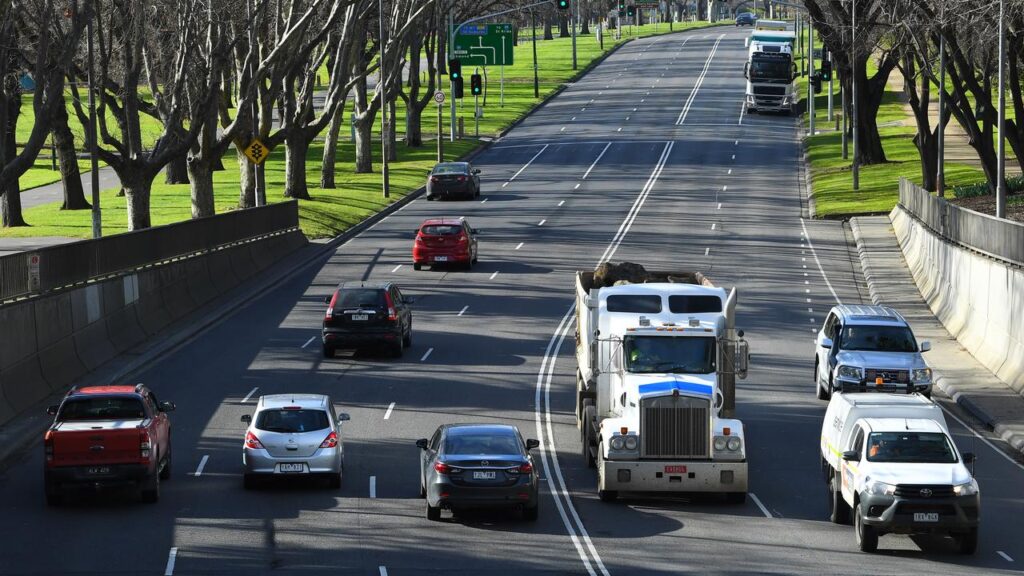
Australian motorists should pay a fee for every kilometre they drive in order to maintain and build the nation’s road network, according to two studies into transport reform.
But the reports, released on Wednesday, disagree over who should pay road user charges, when it should be introduced, and how much it should demand of drivers.
The calls come less than a week before the federal budget is due to launch and months after Treasurer Jim Chalmers confirmed the government would investigate a road user charge to apply to electric vehicle drivers.
Transport Australia will launch its report, Road to Reform, at the Transforming Transport Summit in Melbourne on Thursday.
It found fuel excise revenue would continue to fall as electric vehicle sales rose, and most Australians would support a road user charge to replace fuel excise.

Support for a road user charge was highest among electric and hybrid vehicle drivers at 71 per cent, which Transport Australia chief executive Ehssan Veiszadeh said proved the public was ready for change.
“Fuel excise was designed for a different vehicle fleet and a different economy,” he said.
“The question is no longer whether Australia needs a new funding model – the question is how we design one that is fair and nationally consistent.”
A road user charge should be prioritised in the current term of government, the Transport Australia report said, and could be introduced to all vehicle types after the removal of fuel excise, or to electric vehicles alone.
But a study from The McKell Institute, backed by the Electric Vehicle Council, recommended a different approach.
The study analysed taxes in the UK and New Zealand and found a road user charge should be introduced after electric cars represented 30 per cent of Australia’s fleet, and should be phased in as their adoption increased.
The rate charged to drivers should be based on income, the report found, with four levels ranging from 3.74 cents to 12.86 cents per kilometre.
The sliding scale would ensure working families in outer suburbs were not charged disproportionately, McKell Institute chief executive Edward Cavanough said.
“They drive the furthest and have the fewest alternatives to driving,” he said.
“A per-kilometre charge would penalise them for that and that’s not a fair outcome.”
The road user charge should be applied to all vehicles once electric vehicles passed 75 per cent, the report said, and could replace fuel excise.

A carbon surcharge of 0.5 to 1.5 cents per kilometre could then be applied to motorists driving fuel-powered vehicles to act as a disincentive.
The reports come one day after the federal government confirmed it would extend its Electric Car Discount until April 2027 and then restrict the full discount to vehicles priced under $75,000.
AAP