Big bank books huge profit, warns economy is slowing
Derek Rose and Kaaren Morrissey |
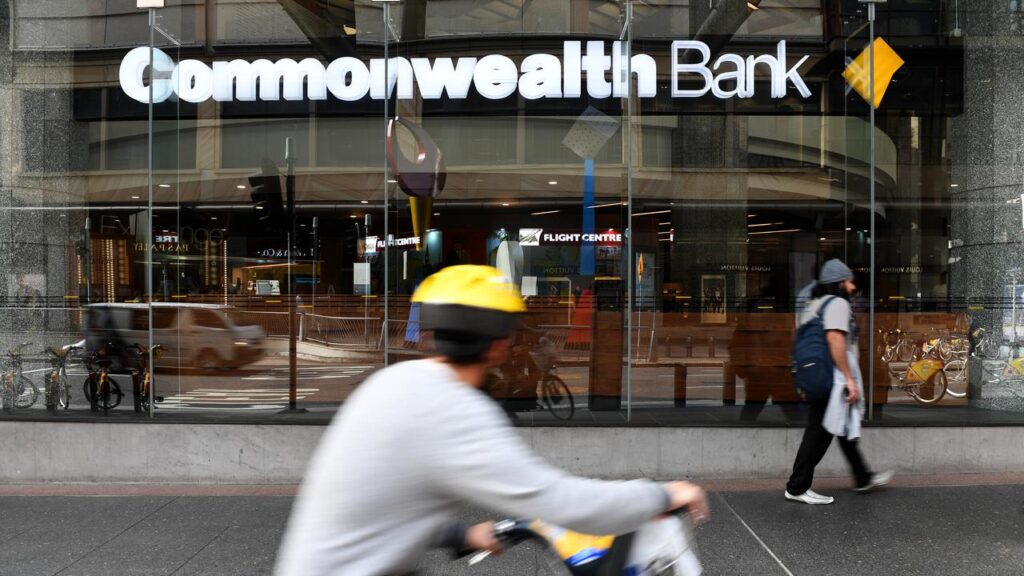
Australia’s economy remains resilient but growth is slowing as higher interest rates and inflation continue to pressure household budgets, the nation’s biggest bank says, after delivering a massive annual profit.
Commonwealth Bank of Australia has reported a statutory full-year net profit of $10.9 billion, up seven per cent from the previous year, on a seven per cent boost in revenue to $30.2 billion.
Cash net profit – its preferred measure of profitability – came in at $11 billion, also up seven per cent, and ahead of market expectations.

“The Australian economy has remained resilient, supported by historically low unemployment and longer-term investment,” chief executive Matt Comyn said on Wednesday.
“However, growth is slowing, with higher interest rates and inflation placing uneven pressure on household incomes and economic activity.”
Mr Comyn noted that housing activity has softened from a “high base”, after federal government policy changes weighed on the property market.
But the bank’s loan application numbers appear to have stabilised in recent weeks, he added.
The results came after the Labor government’s changes to negative gearing and capital gains tax concessions for property in the May budget, which led to some of the biggest monthly house price declines since 2022.
On Monday, Westpac revealed its mortgage applications had fallen 20 per cent since the budget, while NAB indicated on July 31 that its home loan applications were down 15 per cent in the June quarter.

Homebuyers did get some relief on Tuesday when the Reserve Bank of Australia left rates on hold for a second straight meeting.
However, economists deemed it a “hawkish hold” because the central bank expressed a bias toward future rate hikes.
“Australian mortgage holders have had an interest rate reprieve but are not out of the woods just yet,” Betashares chief economist David Bassanese said.
In 2025/25, CBA grew at or above system – which refers to the average banking sector performance – in each of its five core domestic product categories – home lending, business lending, consumer finance, household deposits and business deposits.
“It is the first time CBA has achieved this and the first time any major Australian bank has done so in the past 15 years,” Mr Comyn said.
“We remain the main financial institution for one in three Australian and one in four Australian businesses.”
CBA reported a net interest margin – which reflects the earnings it makes on its lending business – of 2.05 per cent, which was down three basis points on 2024/25 although it was two points higher from the first half of 2025/26.
CBA shares were trading at just under $174 on Tuesday afternoon, down 2.5 per cent from Monday but up 8.1 per cent since the start of the year.
That still gives CBA a trailing price-to-earnings ratio of 28.7, a valuation usually seen in fast-growing tech companies rather than mature businesses.
A price-to-earnings ratio measures a company’s share price to its earnings per share and shows how much investors are willing to pay for each dollar of a company’s profits.
By that metric – which implies investors are paying almost $29 for each dollar of earnings – CBA is likely the most expensive bank stock in the developed world, experts have said.
US banking giants like Bank of America and Morgan Stanley trade at price-to-earnings ratios of around half that.
CBA declared a final dividend of $2.70, taking the total for the year ending June 30 to $5.05, which was a four per cent improvement on the prior year.
AAP