US military destroys five Iranian oil tankers
KONSTANTIN TOROPIN |
The US military says it has destroyed five Iranian oil tankers in response to the latest attacks on its warships and Tehran hit back at American targets in Jordan, the latest burst of back-and-forth strikes that have lurched the sides back toward open hostilities in a more than six-month war.
Following the latest American strikes, Iran launched missiles toward US targets in Jordan, Iranian state-run media said.
The latest strikes are part of a dual economic and military approach by President Donald Trump as he struggles to bring an end to the war.
The Trump administration also imposed sanctions on additional elements of Iran’s aviation industry, targeting more than two dozen commercial and private airlines as well as foreign cargo service providers, in its new push to isolate Tehran from its trading partners.
Both the US and Iran are seeking to exert control over the Strait of Hormuz, where about one-fifth of the world’s oil passed before the war began.
Rising energy prices are posing political problems for Trump and his Republican Party ahead of the November midterm elections. A barrel of international standard Brent crude briefly climbed as high as $US99.46 ($A137.68) on Tuesday.
The US forces also destroyed three Iranian oil tankers on Saturday after Iran’s Revolutionary Guards tried to attack a US aircraft carrier and destroyer with ballistic missiles, warning that it would, “if necessary, destroy Iran’s limited and exposed oil fleet”.
Iran later said it planned to announce a new “exclusion zone” near the Strait of Hormuz.
Secretary of State Marco Rubio said the US would not allow Iran’s attacks to go unanswered.
“Iran continues to try to hit US naval ships. And for every time they do that or try to do that, they’re going to lose tankers. And I think you’ll see that again today,” Rubio told reporters when asked about the latest attacks.
Danny Citrinowicz, an Iran expert at Israel’s Institute for National Security Studies, warned that such back-and-forth strikes risked more retaliation and further impact on the global economy.
“There is no kinetic solution to the Strait of Hormuz problem,” he said on X.
“Every attempt to impose one only brings Washington and Tehran closer to an escalation that may become increasingly difficult to control.”
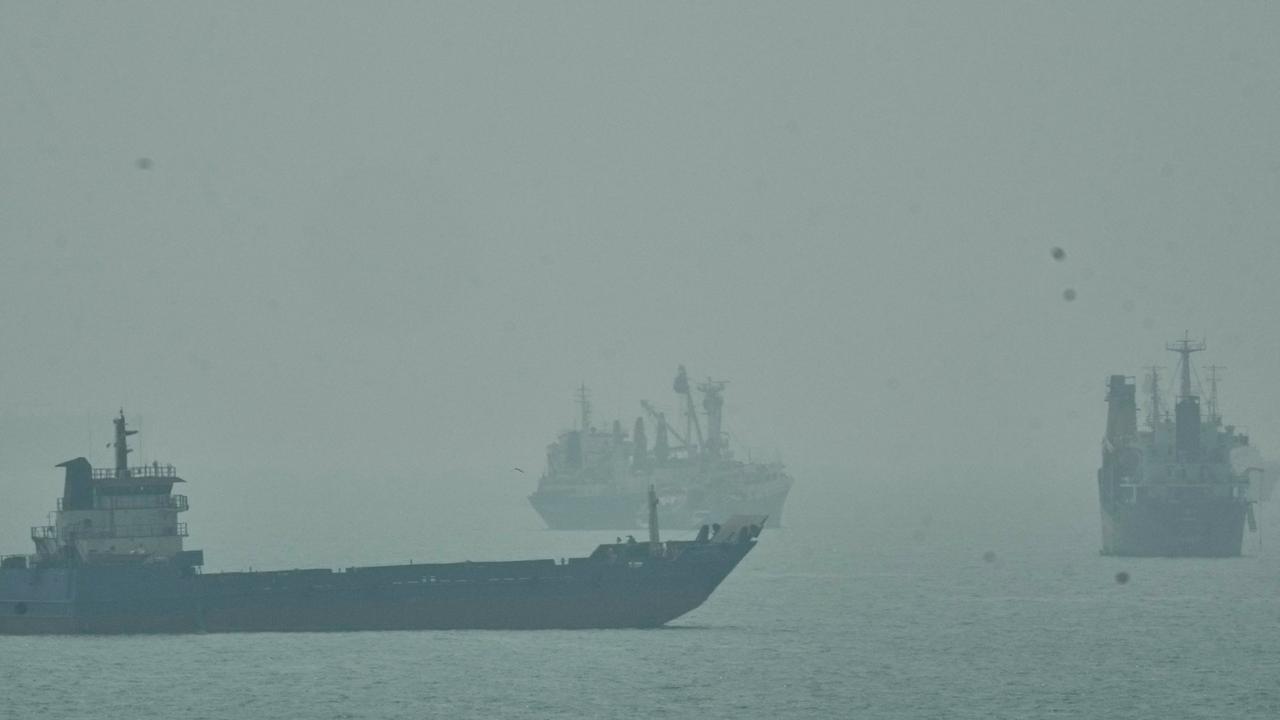
US Central Command said the Iranian tankers destroyed on Tuesday were the Kivik, Charminar, Horizon 1 and the Riesco in the Gulf of Oman.
The US military also destroyed the vessel Derya, which was located near Kharg Island in the Strait of Hormuz. The statement said the crews of the five vessels were told to abandoned ship before the attacks.
Iranian state television said US forces attacked Iranian oil tankers near the southern port of Jask and near Kharg Island in the Persian Gulf.
An Iranian state TV reporter said an Iranian tanker was struck near the coast of Yekbeni.
State TV later reported that the US military attacked a second tanker near waters off Jask.
Separately, state television reported that another Iranian tanker was attacked in the Kharg Island anchorage area.
Iran’s Revolutionary Guard Navy had warned crews of oil tankers near ports in Kuwait and Bahrain to immediately leave their vessels, saying the ships could be targeted in retaliation for US attacks on Iranian tankers.
In Saudi Arabia, the Houthis, who control most of Yemen’s populated areas including the capital, said they had launched a broad operation deep into Saudi territory.
They used drones and missiles to strike a Saudi airbase in the southern city of Khamis Mushait as well as Saudi state oil company assets in the cities of Abha, Najran and Jazan.
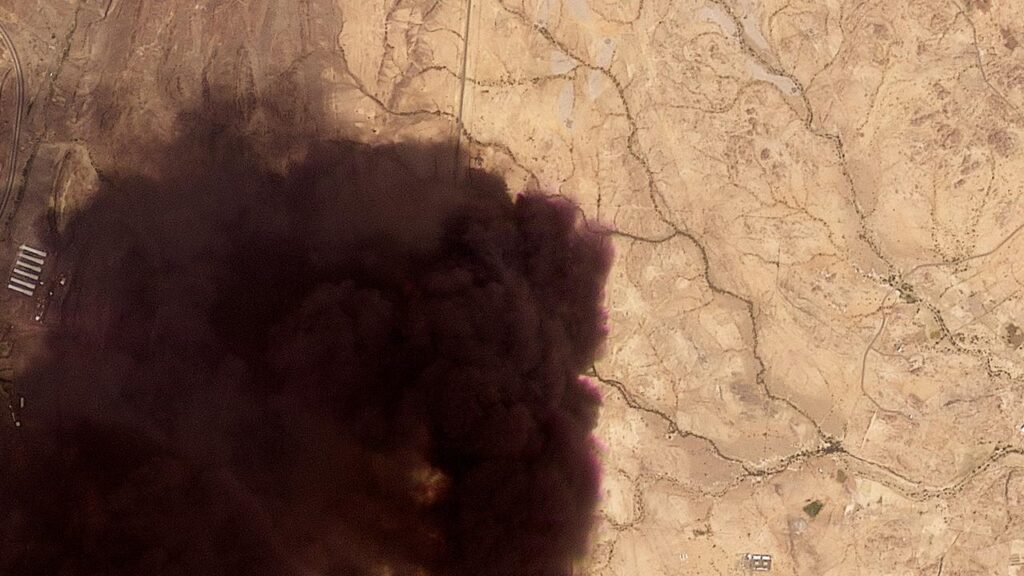
NASA satellite images showed a thick cloud of black smoke over the Jazan refinery and a column of white smoke rising from an oil distribution centre in Abha.
Saudi authorities described blazes at the sites and said women and children were among the 73 people hurt.
The reports of such large numbers of wounded suggested the attacks were among the biggest carried out against Saudi Arabia since the US and Israel launched their war against Iran in February.
A US blockade of Iranian ports has squeezed the country’s economy by limiting its oil exports, while the American military has been helping a limited number of ships transit on a route through the Strait of Hormuz off Oman.
Tehran wants ships to follow a route that it chooses through the strait, which was considered an international waterway before the war.
with Reuters
AP