Aussie researchers create a robot vacuum for oil spills
Jennifer Dudley-Nicholson |
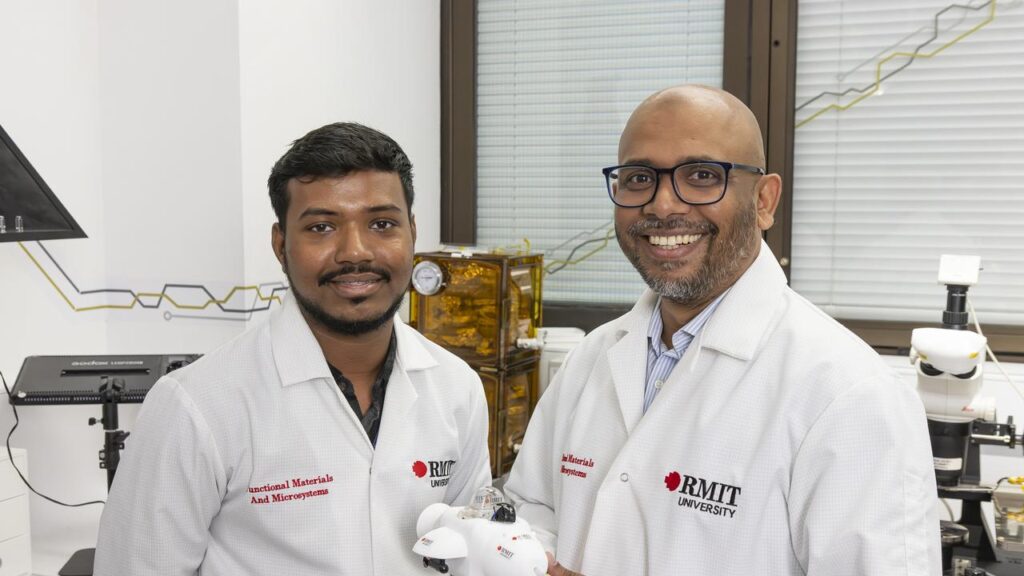
With tiny propellers at its side, a plastic canopy up top and a smooth body no bigger than a shoe, the robot looks a bit like a bath toy.
But the creation from RMIT University is designed for much bigger bodies of water and significantly bigger tasks: namely, cleaning oil spills in the sea.
Researchers announced the project on Tuesday, unveiling a working prototype of the oil-collecting robot they plan to scale up to the size of a dolphin.
The announcement comes days a large oil spill was reported off the coast of Mexico, polluting beaches in Veracruz, and an oil tanker exploded in waters near Kuwait in the Middle East.

The Australian robotic creation, detailed in the journal Small, is designed to collect oil spilled in water without the use of chemicals.
The miniature robot instead uses a filter inspired by the water-resistant body of a sea creature, lead researcher and engineering senior lecturer Md Ataur Rahman said.
“This is the first time we have developed a material inspired by the sea urchin so it has a lot of spikes that helps to absorb the oil,” he told AAP.
“We engineered it in a way that it’s not harmful for the water.”
The filter used by the robot is covered in tiny spikes that can only be seen under a microscope and that hold pockets of air that make water roll off the surface while it absorbs oil.
The oil is stored inside a container in its hull, collecting two millilitres of oil each minute.
The process did not use harsh chemicals or fire like other methods, Dr Rahman said, and future versions of the robot would be significantly larger and use software to work autonomously.
“We want to make an artificially intelligent robot that can go to the area where the spill is, it can hoover up the oil and once the container is filled it can come back to the station and put the oil in the station,” he said.
“I want to make it like a robot vacuum (works) for the home.”
One of the biggest goals for the project, PhD researcher Surya Kanta Ghadei said, was to ensure toxic materials did not affect sea creatures.
“Growing up in India, I saw the impact oil spills can have on marine life, especially turtles,” he said.
“I wanted to create something that could help responders act faster and keep wildlife out of danger.”
The next stage of the robot’s development will involve field testing and assessing the robot’s durability.
AAP