‘Very special to us’: stockman’s final journey home
Abe Maddison and Lloyd Jones |
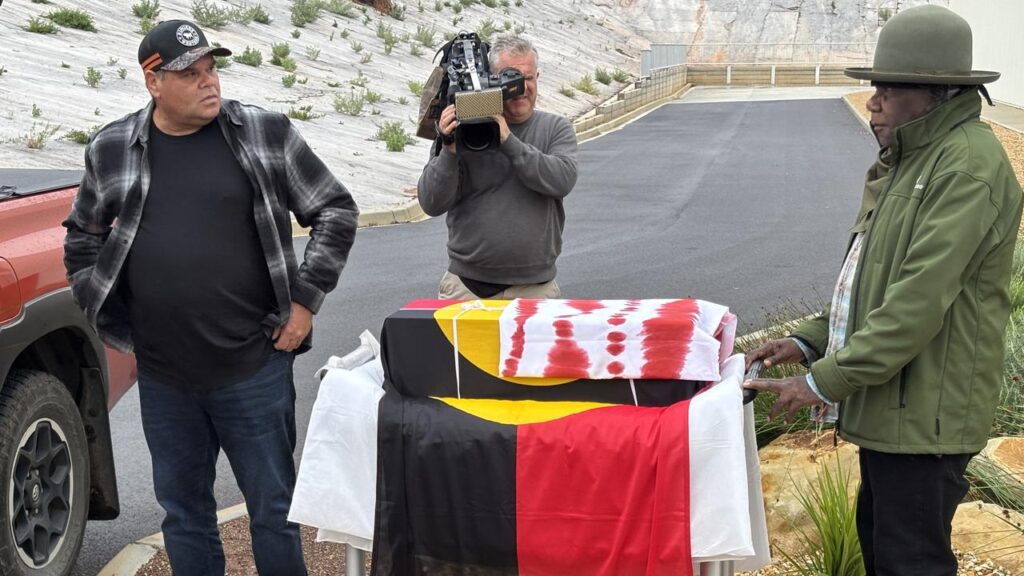
The remains of an Aboriginal stockman kept in a museum for 60 years have been handed to his family, who have begun a marathon journey to rebury him on Country.
Thomas Cowell was droving cattle in South Australia’s Far North when he was found dead of a suspected heart attack at Kopperamanna Bore in March 1959, aged about 65.
Police were called and buried the Lower Southern Arrernte man at a nearby dam but in 1966, his grave site was disturbed by flooding and police returned to collect his remains.

Officers couldn’t locate any family and sent the remains to the South Australian Museum.
Documents indicated Mr Cowell was a worker at Mt Dare Station.
Elders recently helped identify extended family who were notified and requested Mr Cowell be returned to Country for burial within the Witjira National Park near Mt Dare.
At a ceremony in Adelaide on Monday, elder Raymond Finn and other family members accepted Mr Cowell’s remains, before embarking on the 1200km road trip.
It was “a special time … because we’re taking him home”, Mr Finn said.
“I’ve taken other bones back to Queensland, to family there, but this one here is very special to us, to our family, so we’re taking him back to Mount Dare.”

Thursday’s reburial will be near other repatriated Aboriginal remains discovered nearby in the 1930s and reburied in 2024.
SA Aboriginal Affairs Minister Kyam Maher said the handover was a significant moment.
It occurred ahead of Reconciliation Week, marking 59 years since the 1967 referendum recognised Aboriginal people in the constitution.
“The museum … has done a lot of work in repatriation in recent years, right across South Australia, remains are being returned and reburied again,” Mr Maher said.
SA Museum Aboriginal Heritage and Repatriation Manager Anna Russo said the museum had a program to progressively return thousands of Aboriginal remains collected from the 1870s through to the 1980s.
“Over the last few years, we’ve been working with communities to return their ancestors back to Country and burial, so that number is coming down,” she told AAP.

Now obsolete instructions from the Commissioner of Crown Lands meant any Aboriginal remains found or dug up through public works had to go to the SA Museum.
“It goes back to those racist theories around evolution and pseudoscience, people thinking they could measure and do scientific studies on the remains of Aboriginal people,” Ms Russo said.
SA Museum director Samantha Hamilton said the repatriation was “really about family and people”.
“This work is really deep. It’s hard work, but it’s very important work,” she said.
“I want to acknowledge … the team at the museum who do this deep research and ensure that community is connected with their ancestors, and their ancestors are returned home.”
It was estimated about 10,000 Aboriginal remains were collected by museums across Australia, with the SA Museum accounting for about half of them, she said.
AAP