Federal budget to dominate the economic agenda
Jacob Shteyman |
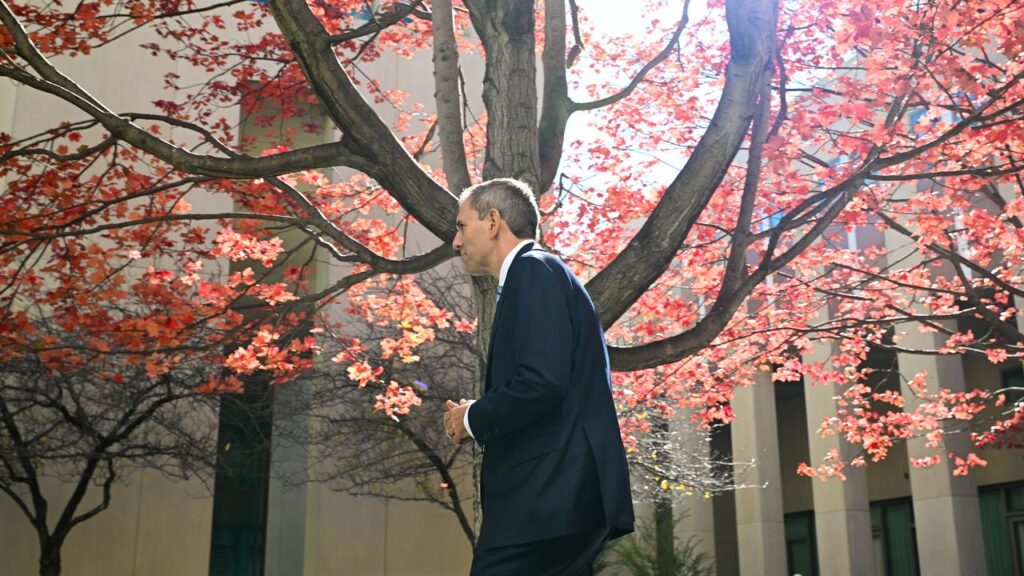
The federal budget will this week overshadow local data, with Jim Chalmers’ fifth fiscal blueprint key to future Reserve Bank interest rate calls.
The economy was already speeding above its limit before the Middle East conflict erupted in February, driving up oil prices, and the Reserve Bank is hoping the treasurer doesn’t add fuel to the inflation fire on Tuesday.
With supply constrained, a boost to demand is the last thing governor Michele Bullock needs after three straight interest rate hikes.

Oxford Economics Australia’s Harry Murphy Cruise predicts the Middle East conflict will improve the budget bottom line for this financial year by about $11 billion through higher commodity prices, income tax and GST revenue.
That will give the government a “tantalising” windfall to spend on household cost-of-living supports.
“But if they do, Australia’s burgeoning inflation problem could get much worse,” Mr Murphy Cruise said.
“Firms are already struggling to keep costs in check. If they have to compete with governments for workers and capital, prices would rise even higher.”
This makes policymaking exceptionally difficult, according to HSBC chief economist Paul Bloxham.
The Reserve Bank had been willing to wield its “blunt instrument” to drive down demand, he said, but “a surgical approach to the budget would be optimal”.
The government is yet to announce additional household supports beyond cutting fuel excise, which is expected to cost more than $2.5 billion in foregone revenue.

But there is reported speculation wage and salary earners could receive a $200 to $300 one-off “earned income offset”.
Citi economists Josh Williamson and Faraz Syed estimate this would cost $3 billion to $4.4 billion if applied to all salaried employees.
“Assuming all of this is spent, it would at most add just 0.1 per cent to yearly (headline inflation),” they said.
“The big-picture view of the expected change in the underlying cash position shows little cause for the RBA to be alarmed.”
More importantly, the duo say, will be how long the Middle East conflict and energy price shock lasts, what happens to domestic inflation expectations, and how quickly recent rate rises flow through the economy.
Extending the fuel excise cut, combined with additional tax relief or subsidies, could push up underlying inflation and create more headaches down the track.
Economists at Commonwealth Bank and ANZ think the Reserve Bank’s hiking cycle is over but NAB and Westpac expect further rises.

Westpac chief economist Luci Ellis now believes the central bank will wait to see what happens in Iran before back-to-back hikes in August and September, after previously picking a fourth straight rise in June.
Ms Bullock acknowledged on Tuesday that the hikes gave the Reserve Bank board “space” to see how the conflict played out.
But Dr Ellis expects the second-round effects of high fuel prices to be greater than Reserve Bank forecasts imply, which could result in a “wake-up call” in June and September quarter inflation data.
The federal budget and the Fair Work Commission’s annual wage review decision in June would be pivotal, she said.
Lending and wages growth data will also be released on Wednesday.
Meanwhile, investor interest on Wall Street has been piqued by gains in AI stocks and stronger-than-expected US jobs figures.
The S&P 500 climbed 0.84 per cent to end Friday at 7,398.93 points. The Nasdaq gained 1.71 per cent to 26,247.08 points and the Dow Jones rose 0.02 per cent to 49,609.16 points.

Australian share futures slid 42 points, or 0.47 per cent, to 13,148.
About $43 billion was wiped from Australian indices on Friday, as oil prices surged on the prospect of further military action between the US and Iran.
The S&P/ASX200 fell 133.7 points, down 1.51 per cent, to 8,744.4, as the broader All Ordinaries lost 126.5 points, or 1.39 per cent, to 8,980.5.
AAP