Smelly spawning heralds new life on fragile reef
Aaron Bunch |
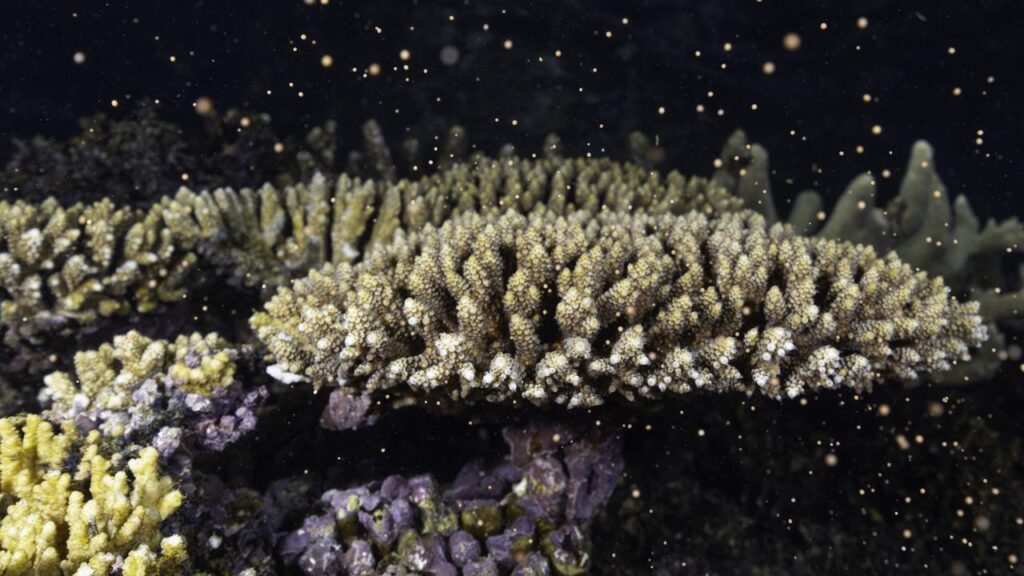
A stinky underwater blizzard of new life has erupted on a cyclone-ravaged coral reef still recovering from a deadly marine-bleaching event.
Hundreds of millions of coral sperm and eggs have spawned on the 260km-long World Heritage-listed Ningaloo Reef in Western Australia’s northwest in recent nights.
The mass fertilisation was witnessed by scientists who collected millions of “early-stage babies” from dense slicks of bright-pink coral spawn that had risen to the surface of the ocean 1200km north of Perth.

“The first thing that hits you is the smell. It’s unmistakable … absolutely overwhelming,” CSIRO marine scientist Damian Thomson said.
“It forms these really spectacular pink trails of spawn.”
The spawning is the first major reproduction event since an unprecedented marine heatwave fatally bleached large areas of the reef two summers ago.
“We’re absolutely overjoyed. It was a big win for the reef,” Dr Thomson said.
It comes just weeks after Tropical Cyclone Narelle swept down the Ningaloo coast as a category four storm, destroying buildings, cutting roads and flooding rural properties.
Scientists feared the fragile reef system could also have been affected and that the spawning event could have been disrupted, but it escaped largely unscathed.
Researchers will protect the harvested embryos in floating pools for about a week until they’re developed enough to be released onto damaged areas of the reef, where it is hoped they thrive and become the next generation of corals.

Coral spawning is triggered by water temperature, tides and the moon.
“On the Great Barrier Reef, you generally see it four or five nights after the full moon, but in WA, we’re more seven to nine nights after it,” marine scientist James Gilmour, of The Australian Institute of Marine Science, said.
The colourful slicks floating on the ocean’s surface are the coral’s eggs and sperm.
After the egg is fertilised, it divides multiple times before producing larvae.
“They look very similar to maggots,” Dr Gilmour said.
When developed enough, the larvae attach to the reef and slowly metamorphose into a tiny animal called a coral polyp.
The polyps secrete calcium carbonate, which forms their skeleton, before multiplying and expanding to become a coral colony.
The research is part of an $11 million state government and multi-agency collaborative effort to help WA reefs recover from the 2024-25 marine heatwave.

“Our reefs were badly impacted, but Ningaloo is still an amazing place, and we are well placed to look into regeneration approaches,’ Dr Gilmour said.
Led by the WA Marine Science Institution, the regeneration project will trial techniques adapted from the Philippines and the Great Barrier Reef.
According to WA Environment Minister Matthew Swinbourn, the project will build knowledge to improve responses to future heatwaves and bleaching events and bolster reef resilience against cyclones.
AAP