Houthis claim first attack on Israel since start of war
|
Yemen’s Houthis have claimed responsibility for a missile attack on Israel, their first since the war in the Middle East started.
Brigadier General Yahya Saree, a military spokesman for the Houthis, issued the claim in a statement by the rebels’ Al-Masirah satellite television.
The Israeli military said it had intercepted the missile.
The attack came hours after Iran-aligned Houthis said they were prepared to act if what the group called an escalation against Iran and the “Axis of Resistance” continued in the war launched by the US and Israel on February 28.
Houthi involvement in the war would risk broadening and prolonging the conflict, given their ability to strike targets far beyond Yemen and disrupt shipping lanes around the Arabian Peninsula and the Red Sea.
Earlier at least 12 US soldiers were wounded, two of them seriously, in an Iranian strike on Saudi at a military base in Saudi Arabia.
The missile attack on Prince Sultan Air Base also damaged several US refuelling aircraft, said two US officials, who spoke on condition of anonymity.
Over the past few hours, air defence systems have been activated and drones intercepted in the United Arab Emirates, Kuwait and Bahrain.

Meanwhile Secretary of State Marco Rubio said the US expects its military operations against Iran to conclude within weeks, not months, and Washington can meet all its objectives without using ground troops, .
Rubio told reporters on Friday after meeting G7 counterparts in France that Washington was “on or ahead of schedule in that operation, and expect to conclude it at the appropriate time here – a matter of weeks, not months”.
While he said the US could achieve its aims without ground troops, he acknowledged it was deploying some to the region “to give the president maximum optionality and maximum opportunity to adjust the contingencies, should they emerge”.
Rubio discussed with G7 foreign ministers the possibility that Iran, even after the conflict ends, could try to impose shipping tolls through the Strait of Hormuz.
Washington has dispatched two contingents of thousands of Marines to the region, the first of which is due to arrive around the end of March aboard a huge amphibious assault ship. The Pentagon is also expected to deploy thousands of elite airborne soldiers.
The deployments have raised concerns that the war, which the US and Israel launched on February 28 with air strikes that killed Iran’s supreme leader and other top officials, could turn into a prolonged ground battle.
President Donald Trump has appeared anxious to wind down the unpopular war, and emphasised this week what he has described as productive negotiations aimed at a diplomatic solution, despite repeated assertions from Tehran that no such talks have begun.
On Thursday, he extended a deadline by 10 days for Iran to reopen the blockaded Strait of Hormuz or face attacks against its civilian energy grid.
Trump’s special envoy Steve Witkoff said the US was hopeful of meetings with Iran within a week and he expects an Iranian response soon to Trump’s 15-point proposal to end the war.

Witkoff said there were clear red lines for the US, including no uranium enrichment by Iran and the country giving up what he said was 10,000kg of enriched stockpiled material.
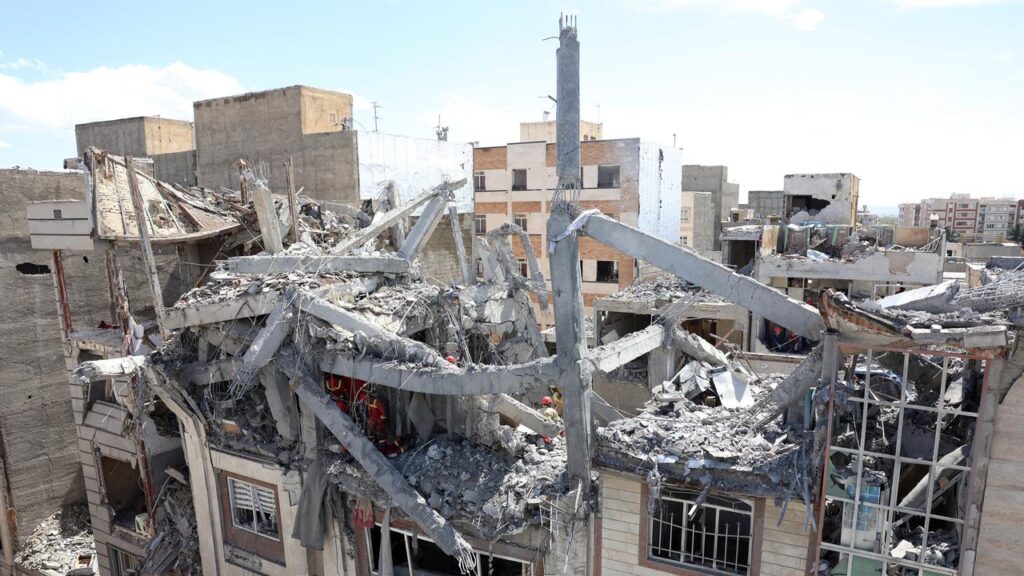
At least five people were killed and seven were injured after a US-Israeli attack on a residential unit in Iran’s northwestern city of Zanjan, Iranian media reported on Saturday.
Iranian Foreign Minister Abbas Araqchi said on X that Israel, in co-ordination with the US, had also hit two steel factories and a power plant.
“Attack contradicts POTUS extended deadline for diplomacy. Iran will exact HEAVY price for Israeli crimes,” Araqchi said, using an acronym for the US president.
In Iran, more than 1900 people have been killed and at least 20,000 injured. Attacks on Israel by Iran’s Lebanese ally Hezbollah have also prompted an Israeli onslaught that has displaced a fifth of Lebanon’s population.
with AP and DPA
Reuters