‘Pretty bad’: recession already a reality for many
Andrew Brown, Noah Secomb and Will Nicholas |
Australia is not in a recession, but its people feel like they are.
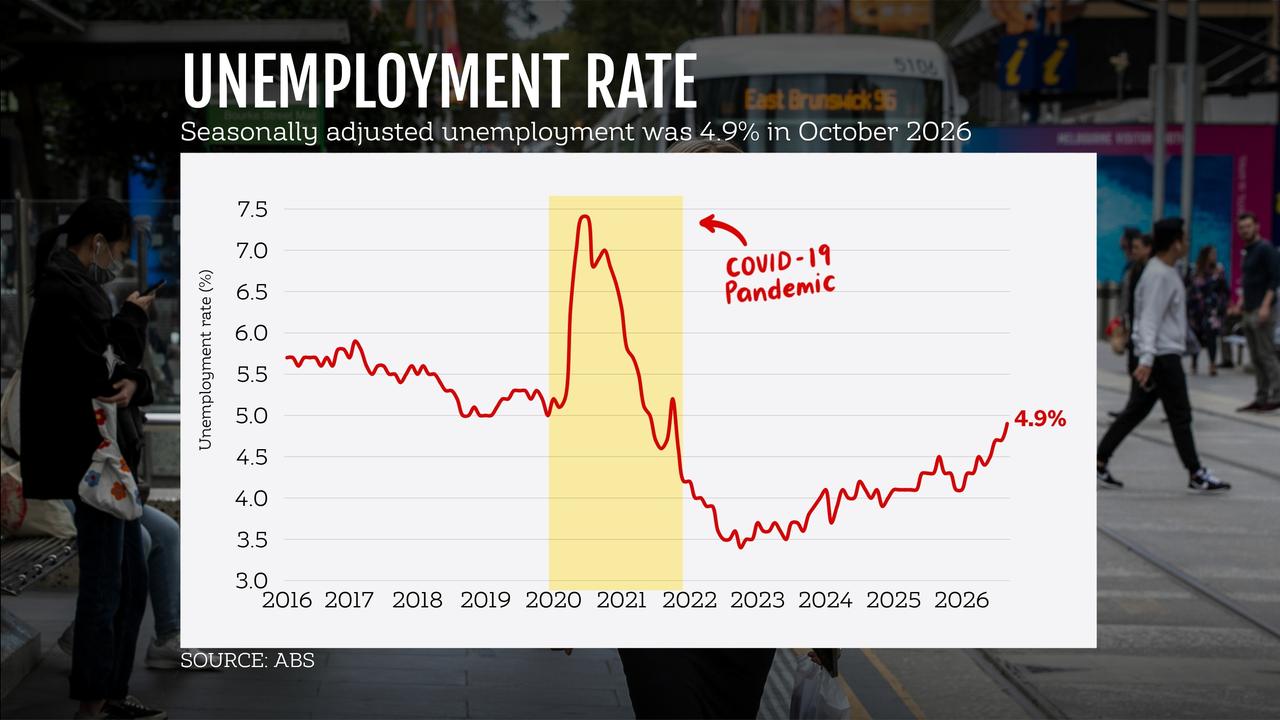
That’s according to economist Jason Tian, who like many boffins was shocked when he saw unemployment jump from 4.7 to 4.9 per cent on Thursday.
The labour force figures for October defied predictions the jobless rate would remain steady, but Dr Tian said the print was even worse than it looked.
“It’s pretty bad across the board,” the Swinburne University academic told AAP on Friday.
“Looking at the participation rate, we also had a bit of drop … it’s also suggesting a lot of people are giving up, not looking for jobs, so that doesn’t even count as unemployed.
“It’s probably worse than what the 4.9 unemployment rate (indicates).”
Thursday’s figures also came before mass job losses at major businesses – including retailers David Jones and General Pants, along with National Australia Bank – make their way into official data.
The high-profile lay-offs have spooked economists and, along with the labour force figures, left government ministers facing questions about whether Australia is barrelling towards a recession.
“The RBA and the Treasury are not forecasting a recession, and I don’t have any reason to dispute that,” Employment Minister Amanda Rishworth told Nine’s Today program on Friday.
Dr Tian said those predictions were little cause for comfort.
“I don’t like using the forecast as an argument, saying there’s no risk or nothing to see here,” he said.
“If you look at the RBA’s forecast, they weren’t forecasting a 4.9 per cent unemployment rate until December 2027, and we were already there last month.”
The employment minister’s reassurances were echoed by fellow cabinet member Mark Butler, who said the “very serious risks to the economy” were being taken seriously.
But the worst had already come to pass for many Australians, according to Dr Tian.
“The general population don’t live by the statistics,” he said.
“If you ask the most productive population working, having a mortgage or building wealth at this stage, they will very much tell you that we’ve probably been in recession for a long time.”
Australians’ real wages fell for a fourth straight quarter, according to figures also released this week, as fast-rising prices blunted the biggest average growth in pay packets for years.
Stubbornly high inflation had also caused the Reserve Bank to hitch the cash rate to its highest level in nearly two decades earlier in November, squeezing borrowers already in the throes of a cost-of-living crisis.
But a technical recession only happens when the economy shrinks for two consecutive quarters.
Dr Tian said the disparity between that definition and the widespread feeling the economy was already there was eroding confidence in policy-makers and financial institutions.
“That basically damages the trust that people have in the government as well as the broader institutions such as the RBA and all the economists,” he said, again referring to the jobless rate hitting the central bank’s estimate more than a year earlier than predicted.
“Forecasting is hard, but when people see such a big forecasting error, they will start to question whether they should trust the institution.”
The coalition has levelled criticism at Labor for pinning economic woes to the fuel crisis caused by the US war with Iran, blaming out-of-control government spending.
AMP economist Shane Oliver said the October data would be the start of a longer unemployment climb, and estimated there was a 40 per cent risk of a technical recession.
“If you’re looking for a recession, this is the sort of thing you’d expect to see along the way,” he said.
The Reserve Bank earlier in November revised its unemployment forecast for the jobless rate to reach five per cent by 2028.
Independent economist Saul Eslake said that figure was more likely to be reached by early 2027, which might help flip an economic switch and historically accurate recession predictor known as the Sahm rule.
“Talk of the R-word would then become more common and have more basis for it,” Mr Eslake said.
AAP