Electric or bust: truck industry demands urgent U-turn
Jennifer Dudley-Nicholson |
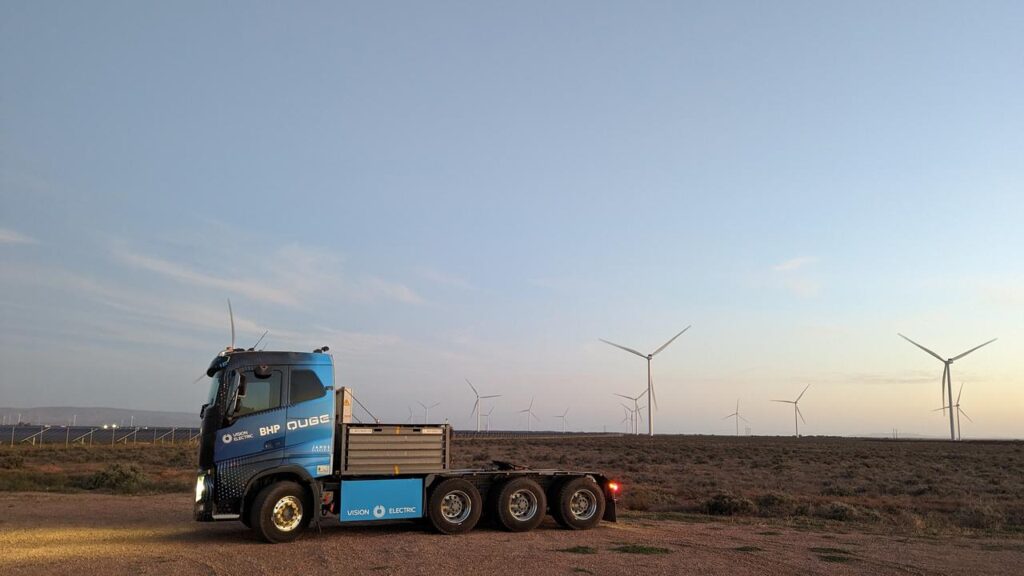
Veteran trucking boss Shirley Saywell is an optimist, an environmentalist, and usually a big fan of Australia’s ‘she’ll be right’ attitude.
But the business owner, who operates eight semitrailers out of Euroa in north-east Victoria, has watched the daily cost of diesel rise by $400 to $500 for each truck over the past month, and it is making her question the nation’s approach.
”I don’t think she will be right this time,” she says.
”I don’t know what my business is going to look like in two weeks or two months’ time but I have real fears we’re not going to be able to operate because either the fuel will be unaffordable or it just won’t be available.”

Brady and Kibble’s transport manager says she wants to replace her diesel freight trucks with electric models for greater security and lower pollution, but she cannot do it alone.
One small company cannot install the high-powered charging infrastructure necessary to support the vehicles, she says, and governments should take urgent action to support the industry.
”We need to put pressure on to ramp things up so we can electrify heavy vehicles,” Ms Saywell tells AAP.
”We’ve done cars, we’ve done buses, we’ve done trams, we’ve done trains, we’ve done ferries even, but the missing link, behind other sectors, is heavy vehicles.”
It is an increasingly popular opinion within the transport industry, coming after 22 organisations signed a letter urging the federal government to accelerate electric truck adoption, and before more groups attend the Freight Forward event in Canberra on Monday.
The Smart Energy Council and Energy Futures Foundation will park an electric prime mover on Federation Mall to spark the conversation.

But overhauling long-haul transport could require a series of changes, including private and public investments, policy reforms, and a significant rethink of the way goods move around Australia.
An electric truck revolution is something New Energy Transport co-chief executive Daniel Bleakley has been considering, researching, and planning for some time.
The company is building a depot for electric prime movers in Sydney’s south-west to establish a low-emissions freight corridor.
Targeting the largest, most fuel-hungry vehicles on Australian roads could make a big dent in transport emissions, which are expected to grow over the coming decade, he says.
”Articulated trucks… make up around three per cent of all commercial vehicles in Australia but they are responsible for 80 per cent of all tonne-kilometres of freight in the country,” he says.
”That means they’re a really fantastic target for decarbonisation (because) if you can electrify just that three per cent, you can have an enormous impact.”
The company completed Australia’s longest electric truck delivery on a single charge in 2025, Mr Bleakley says, with its Windrose prime mover taking a 480km round trip between Sydney and Newcastle.
The electric truck finished the journey 40 minutes faster than its diesel equivalent, as it did not need to slow down when climbing hills, and with significant fuel savings.

Modelling had shown moving from a diesel to an electric truck saved 20 per cent in costs overall, Mr Bleakley says, but the gap would be significantly larger now due to the rising price of diesel, which has topped $3 a litre in urban centres.
Small and medium-sized trucking businesses would need financial help to make the switch, however, both in subsidising their purchase price and in establishing charging facilities.
”The government really needs to take a lead in rolling out infrastructure and that means incentivising the construction of large, high-powered truck-charging depots across major freight corridors,” he says.
”They can really reduce the (capital expenditure) hurdle for smaller trucking companies to get into electrified road freight.”
The Victorian government recently announced grants of up to $300,000 to support investments in electric trucks and their infrastructure and, similarly, the UK government announced an £81,000 ($156,514) rebate for zero-emission truck purchases.
An alternative way to electrify Australia’s biggest vehicles is to upgrade existing trucks, Janus Electric chief executive Ben Hutt says.
The company, based on NSW’s Central Coast, has created upgrade kits that can retrofit five common heavy diesel trucks with electric engines and batteries.

The installation process takes six days, Mr Hutt says, and allows the trucks to use removable batteries that can be swapped out, using a forklift, for a four-minute recharge.
”We believe 80 per cent of the roughly 140,0000 class-eight haulers, which are the big prime movers, could be converted to electric immediately,” he says.
”After five years of life, the diesel truck has its engine and gearbox replaced, and we think that’s the perfect time to convert it to electric.”
Upgrading existing trucks could speed up Australia’s transition to electric freight by years, he says, although policy changes and investments would also be required.
Signalling an end to the diesel fuel rebate for heavy vehicles would encourage more businesses to investigate electric options, while subsidies for truck purchases and upgrades would help companies to act on their findings.
”We do see this as an opportunity, not just for fuel security and electrification, but also for the decarbonisation of heavy transport, which by 2028 will be the single largest emitter in Australia,” Mr Hutt says.
”We need a coordinated, clear message that signals long-term policy commitment to decarbonising transport.”
AAP