Storm could intensify into a cyclone for a second time
Aaron Bunch |
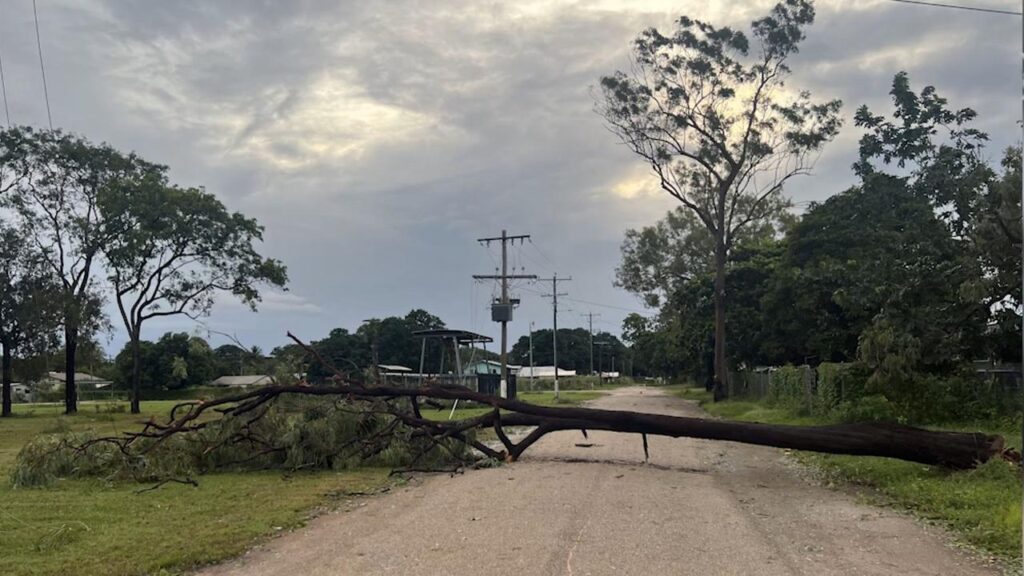
Ex-tropical cyclone Narelle could re-intensify into a category four storm and strike a southern capital city home to millions of people.
The weather system, which weakened to below cyclone strength after making landfall in the Northern Territory on Sunday, dumped heavy rain across the Top End, but caused much less damage than expected.
It crossed into Western Australia’s Kimberley region on Monday, sweeping past the remote town of Wyndham and the Indigenous community of Kalumburu as it tracked southwest.
Narelle is forecast to cross the coast north of Broome into the Indian Ocean on Tuesday and “almost immediately start re-intensifying”, the Bureau of Meteorology says.
The storm could become a category four cyclone, with wind gusts of up to 279km/h, by Thursday as it tracks along the WA coast past Broome and the Pilbara region.
“The tropical cyclone is then forecast to curve back towards the Western Australian coast and could impact places as far south as Perth as we head into the weekend,” senior meteorologist Jonathan How said.
The bureau’s modelling shows a range of paths for the weather system, including crossing the coast near Geraldton and south of Perth in WA’s southwest.
“This is a rare occurrence for Western Australia,” Mr How said.
Narelle crossed the coast in far north Queensland on Friday as a severe category four, knocking out power and communications but causing minimal damage after passing over the Cape York Peninsula.
It then slid west across the Gulf of Carpentaria before a second landfall in the NT as a category three.
High winds toppled trees and caused power outages across the Top End, while heavy rain triggered flash flooding, cut roads and inundated a small number of homes as the weather system tracked toward WA as a tropical low.
Kalumburu Aboriginal Corporation chief executive Kim Holm said the community’s 300 residents were expecting heavy rain and wind when the system passed on Monday night, but nothing out of the ordinary for the wet season.
“To us it’s pretty normal … nothing different to what we generally get,” she said.
The town is well-prepared, and emergency services have been “keeping us informed the whole way so there are no surprises”, she said.
AAP