Muslim community reels after police violence at protest
Alex Mitchell, Kat Wong and Tom Wark |
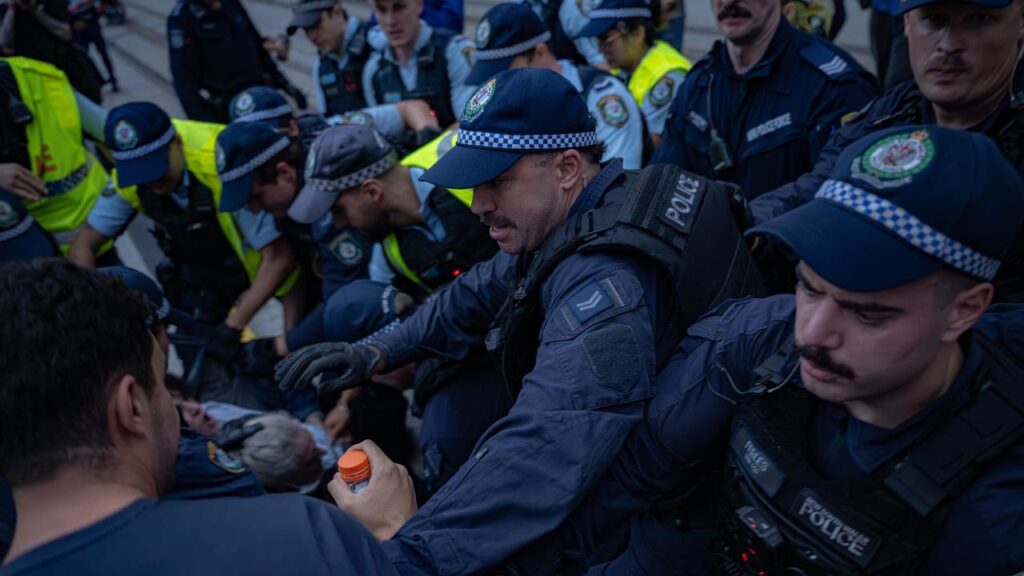
Muslim communities have been left feeling like punching bags after a state premier refused to apologise for a violent police response.
NSW Premier Chris Minns accepted his refusal could be antagonistic while providing steadfast backing of police who forcibly dispersed a group of people praying during a protest over the Israeli president’s official visit.
Police Commissioner Mal Lanyon earlier offered a qualified apology to Muslim groups, but defended the actions of officers as anger continues to rumble over violent policing that broke up the demonstration.
Vision of a group of Muslims being dragged away while performing sunset prayers beside Sydney Town Hall prompted a mass outcry.

Lebanese Muslim Association secretary Gamel Kheir said Mr Minns had rebuffed multiple attempts to engage since the protest, leaving the community feeling brushed aside and degraded.
“Surely there’s an acceptance there was overkill and there were religious sensitivities not taken into account,” he told AAP.
“(Mr Minns and Mr Lanyon) could have said ‘look, we did not mean any harm and if we did cause harm we apologise’, at least that’s a respectful way to get out of the predicament we’re in.”
The premier stared down calls, including from within his own party, for an independent inquiry into policing at Monday’s protest because it might imply the state’s law enforcement watchdog was not fit for purpose.
Officers were seen beating, pushing and pepper-spraying people in Sydney, including medics, who said they were violently pushed while attempting to treat the injured.
Police who grabbed a group of Muslim men kneeling in prayer were following orders to disperse “a violent and aggressive crowd”, the police commissioner said.
“I have apologised for offence taken for interfering with that religious process,” Mr Lanyon told ABC radio.
Mr Minns conceded the Muslim community felt disconnected from society, particularly as a result of “hate, racism and bile” regularly experienced on Sydney’s streets, but defended police actions.
“I genuinely believe NSW Police, their leadership, their regular officers, would never, ever have disrupted a prayer service,” the premier said.

Sheikh Wesam Charkawi, who led the prayers on Monday, said the premier had spoken “disingenuously” about his relationship with the community.
“If the premier believes that a statement and a handshake will do the trick, he has miscalculated,” he wrote on The Muslim Vote website.
“If anything, it shows how little he thinks of the Muslim community.”
Mr Kheir said his community, which runs the nation’s largest mosque, was screaming for senior politicians to take a spike in Islamophobia triggered by the December 14 Bondi terror attack seriously.

Social media posts made by Muslim representative groups in recent days have been inundated with Islamophobic comments, including demands Sydney-born-and-raised leaders “go home”.
“There’s been zero contact and support from any form of politicians, and then the right side of politics has just taken us as punching bags,” Mr Kheir said.
Monday’s protest was organised by pro-Palestine groups to coincide with Israeli President Isaac Herzog’s visit to Australia.
The four-day trip was controversially declared a major event, unlocking further police powers to move on activists across large parts of central Sydney and the eastern suburbs.
After a rally was held at Sydney Town Hall, police thwarted attempts of some to march and formed human barricades across multiple exits.

Officers used pepper spray and rushed at the crowd, including those trying to disperse.
Sydney Lord Mayor Clover Moore backed calls for an arm’s length review into police actions, adding her council was left out of the discussion about the major event declaration.
Street medic Omaim Al-Baghdadi earlier told AAP she was pushed and pulled by police despite wearing a vest identifying herself as medical personnel.
“I found people laying down that were also injured, so I tried to commence treatment there, but again police came and pushed us quite violently,” she said.
Five people were taken to hospital after the protest, while nine people were charged.
AAP