Where home prices could take off or crash land in 2026
Jacob Shteyman |
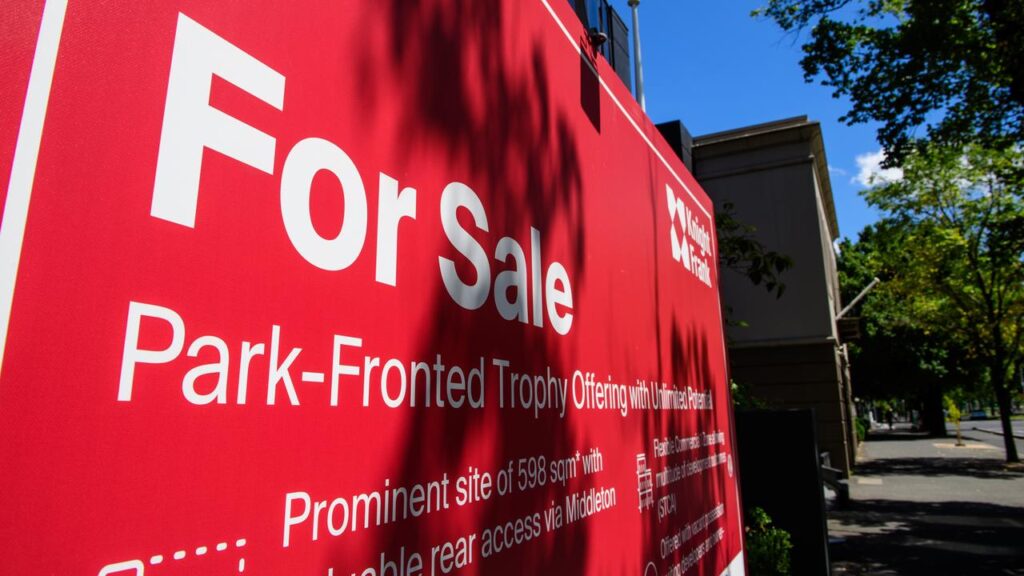
History shows it’s a brave ploy to bet against the Australian property market.
Yet a dramatic reversal in interest rate expectations means 2026 is looking a little softer for real estate.
Opposing forces should see prices continue to break records this year but experts are tipping gentler growth than the 8.6 per cent reported by Cotality in 2025.
Research director at the data house, Tim Lawless, reckons five per cent or lower nationally is now a reasonable estimate as high value-to-income ratios and higher-for-longer mortgage rates constrain demand.

But varying housing dynamics will result in a “tapestry of performance” across the board.
“I think we’ll still see the lower quartile of the market outperforming, given high household debt levels, serviceability barriers and credit constraints will continue to funnel mainstream demand towards those lower price points,” Mr Lawless tells AAP.
The federal government’s expected first home buyer deposit guarantee has further accelerated growth in lower-value properties, which sit under the scheme’s eligibility cap.
Buyer’s agent at Allen Wargent Property Buyers, Pete Wargent, says the tight rental outlook is also encouraging first homebuyers to jump into the ownership market as soon as practicable.
Mid-tier centres Adelaide, Perth and Brisbane have outperformed the traditional hot spots of Sydney and Melbourne in recent years.
Mr Lawless says the landscape differs from city to city but Adelaide could be most at risk of a correction, given dwelling value to income ratios are close to overtaking Sydney.
“Adelaide probably is higher risk than … Brisbane or Perth of going through a correction simply because it doesn’t have the same fundamentals as those two cities,” he explains.
“It doesn’t have as diverse an economy, it’s got negative interstate migration now, whereas WA and Queensland still have very strong rates of interstate migration supporting demand.”

Mr Wargent also calculates that some pockets of the country are vulnerable to a correction.
Pushed out of inner-city areas by affordability constraints, buyers are flocking to cheaper and more illiquid regional markets, he says.
“It’s even happened in Darwin, to some extent, with buyer’s agencies pushing hundreds of clients into what was the cheapest capital city market, and prices have surged,” he says.
“This may see investors experiencing short-term price gains but it’s a risky strategy if you aren’t one of the early buyers in the cycle.
“When the tide goes out some investors will get burned.”
Finding value is increasingly challenging but Mr Lawless likes the look of Melbourne as a “roughie”.
“You’d have to think Melbourne has got some room to move upwards,” he says.
With a dwelling value to income ratio of 7.1, Melbourne is the third most affordable capital city, after Canberra and Darwin.

And with a median dwelling value of $827,000, it’s cheaper than Adelaide, Perth, Brisbane, Sydney and Canberra.
But while it has a lot going for it from an affordability standpoint, Melbourne still isn’t attracting a large amount of interstate migration, given Victoria’s weak economy, Mr Lawless says.
Price growth in Sydney slowed towards the end of 2025, with values actually receding 0.1 per cent in December.
However eyes will be on Australia’s glamour market to see if more records tumble this year.
Mr Wargent believes it’s a matter of time before the $141.5 million sale record, set when a penthouse at the top of One Sydney Harbour in Barangaroo settled last year, is broken again.
Sydney’s eastern suburbs (for houses) and CBD (for penthouse apartments) are prime candidates.
“Some other cities are pushing capital away (like London with its proposed mansion tax),” he says.
“So for as long as Australia remains open to capital inflows, real estate will continue to be a store of wealth for the uber-wealthy and tech entrepreneurs.”

The NSW government push to boost housing density in a bid to catch supply up to demand should start to see more apartment development over the next couple of years.
But Mr Lawless says feasibility remains the main barrier for developers bringing more supply onto the market.
“You can streamline the approvals process as much as you want but if the private sector can’t deliver stock to the marketplace profitably, they’re not going to be building anything,” he says.
For AMP chief economist Shane Oliver, a number of factors will keep the upward pressure on prices.
Among them, he cites the hangover of three 2025 interest rate cuts, demand-boosting government schemes, improved consumer confidence and the ongoing housing shortage.
But he says the potential for rate increases in 2026 as well as banking regulator APRA’s efforts to tighten controls on riskier forms of lending, should take some of the heat out of the market.
So too might slower population growth, with figures released on Friday pointing to an expectation net overseas migration will moderate in 2025-26 before declining further.
The Centre for Population data indicates population growth of 1.3 per cent falling to 1.2 per cent from 2027, lower than the average of 1.4 per cent experienced in the 2010s.
AAP