‘Classic glass cliff’: women leaders mark Liberal first
Ben McKay |
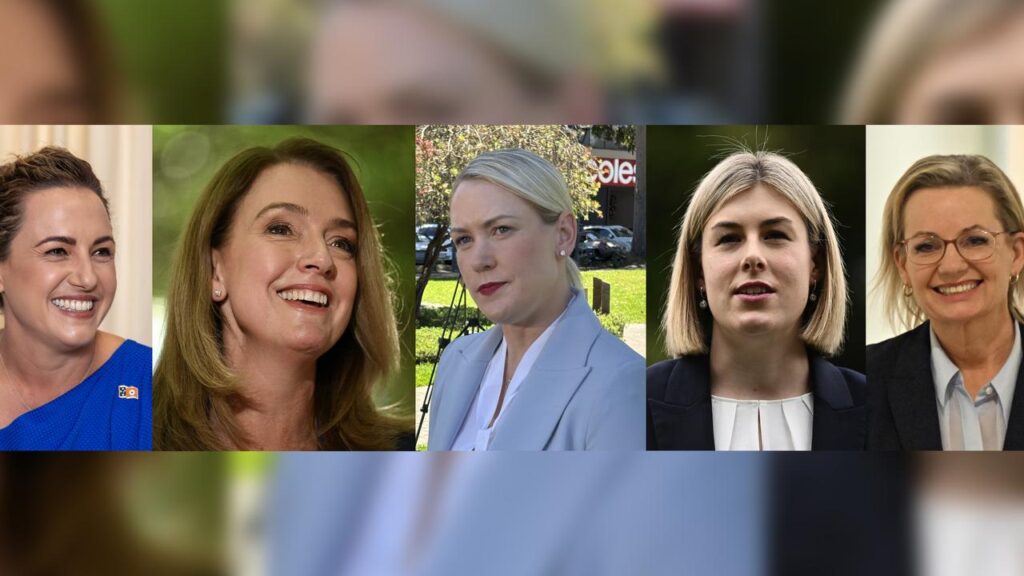
For the first time, a majority of Australia’s Liberal leaders at federal, state and territory level, are women.
That could be the party distancing itself from Scott Morrison and Peter Dutton, its last two federal leaders, who were loathed by women.
The new leaders might also be placeholders, part of the “glass cliff” phenomenon, in which female leaders are given the job only when their party is in an unwinnable position.
Or it could be the meritocracy finally catching up in Australia’s centre-right party, which has long shunned quotas to increase the number of women in its ranks.
Ashton Hurn’s recent election in South Australia has taken the number of female Liberal leaders to five, alongside Sussan Ley (federal), Kellie Sloane (NSW), Jess Wilson (Victoria) and Lia Finocchiaro (Northern Territory).

The milestone is significant, given two branches – the federal party and Victoria – had never elected a woman to lead it until this year.
For her part, Ms Ley was thrilled to see women leaders tip into the majority.
“It’s terrific to see strong, energetic women stepping forward to lead our party across the country,” she told AAP.
“Ashton brings real energy and focus at a time when South Australians are facing mounting pressures, from rising power bills and cost-of-living challenges to a health system under strain.
“I look forward to working with Ashton and our wider team as we strengthen our national effort and offer Australians a clear and credible alternative.”
It’s been a tough slog for women rising to the top of conservative politics, and comes with no guarantee of success.
In the 124 years of federation, just one female conservative leader has won a state election and served as premier: Gladys Berejiklian in NSW.
Two women have done so in the territories: Kate Carnell in the ACT in the 1990s and Ms Finocchiaro, the current NT chief minister.
In 1990s Queensland, Liberal leader Joan Sheldon also served as deputy premier with the junior party to the Nationals in coalition.
Otherwise, it’s been defeat after defeat for the 17 lucky enough to lead the party across Australia’s nine federal, state or territory jurisdictions.

Zac Gorman, a historian at the Robert Menzies Institute, said in years gone by conservative women “were less likely to be politically active (and) more likely to take up traditional female roles”.
“When women first entered politics, the stereotype was that women were actually more conservative than men,” Dr Gorman said.
That manifested in the conservative side of politics being the first to elect women MPs in both the federal parliament and five of the six states.
However, that has now flipped, with women now favouring left-of-centre parties.
The Australian Electoral Study had the coalition polling at just 28 per cent support among women at the 2025 federal election under Mr Dutton and 32 per cent under Mr Morrison in 2022.
That’s now at 24 per cent, according to the latest Resolve poll.

“We can’t underestimate the impact that Scott Morrison and Peter Dutton have had on the Liberal Party brand across the country,” Monash associate professor Zareh Ghazarian said.
“So these new leaders are positioning themselves as being different and coming in with a new skillset, differing levels of expertise, and talking about mostly bread and butter issues.”
Blair Williams, a Monash politics lecturer, said female Liberal leaders had saddled up for the job “when the party is at a time of crisis” in most of the current scenarios.
“It’s that classic glass cliff scenario … because the men don’t want to put their hand up,” she said.
“And also, women are seen through a stereotypical perspective as a safer choice and more honest and trustworthy leader.
“Therefore they will be better at steering the ship through the crisis, and then when the crisis is over a man takes their place.”

Dr Williams’ research shows women are often not elected at the right time to win elections.
The exception could be Ms Wilson, who enjoyed a bumper poll on Tuesday, showing her Victorian party was on track to end three terms of Labor government in 2026.
It’s less bright for Ms Ley, with the federal party soul-searching after a thumping loss in May, and Ms Hurn, who faces a near-extinction event at the next South Australian election, according to polls.
“Where (the Liberals are) trying to save the furniture, they try to appeal to women voters … they are the majority of the electorate, slightly, and they have been losing them en masse,” Dr Williams said.
WOMEN TO HAVE LED THE LIBERALS:
Federal: Sussan Ley (2025-current)
NSW: Kerry Chikarovski (1998-2002), Gladys Berejiklian* (2017-21), Kellie Sloane (2025-current)
Victoria: Jess Wilson (2025-current)
Queensland: Joan Sheldon (1991-98), Deb Frecklington (2017-20)
Western Australia: Liza Harvey (2019-20), Libby Mettam (2023-25)
South Australia: Isobel Redmond (2009-13), Ashton Hurn (2025-current)
Tasmania: Sue Napier (1999-2001)
ACT: Kate Carnell* (1993-2000), Elizabeth Lee (2020-24), Leanne Castley (2024-25)
Northern Territory: Jodeen Carney (2005-08), Lia Finocchiaro* (2020-current)
* served as premier or chief minister
AAP