Astronauts to end moon mission in ‘fireball’ re-entry
Joey Roulette |
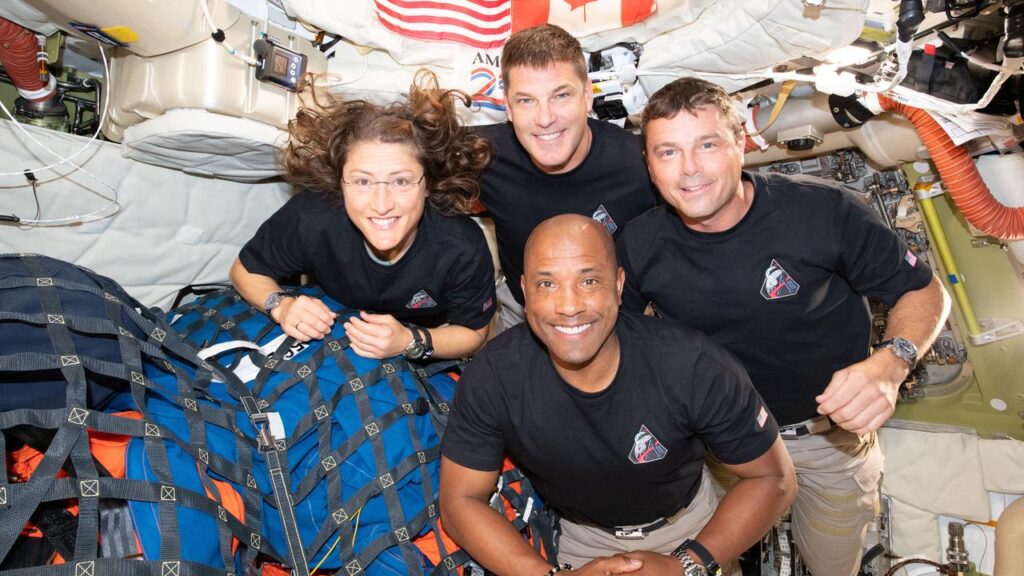
Four astronauts travelling back to earth from the far side of the moon on NASA’s Artemis II mission have spoken of their emotions as they wrap up the unprecedented flight and prepare to re-enter the atmosphere in a “fireball”.
The Artemis II crew, flying in their Orion capsule since launching from Florida last week, are due to splash down off the southern California coast on Friday evening, local time, after reaching the moon this week.
They cruised along a path that took them past the shadowed, lunar far side to become the farthest-flying humans in history.
On the trip back home, they will reach speeds up to 38,365km/h as they enter earth’s atmosphere, a high-risk phase that will put Orion’s heat shield to the test in intense atmospheric friction.
“I’ve actually been thinking about entry since April 3, 2023, when we got assigned to this mission,” Artemis II mission pilot Victor Glover said when asked how he was feeling about the return during a media conference from space.
“There’s so many more pictures, so many more stories, and gosh, I haven’t even begun to process what we’ve been through.
“We’ve still got two more days, and riding a fireball through the atmosphere is profound as well.”
Glover and fellow NASA astronauts Reid Wiseman and Christina Koch, and Canadian astronaut Jeremy Hansen are the first wave of astronauts in a multibillion-dollar series of missions under the Artemis program.
Artemis aims to return humans to the moon’s surface by 2028 before China and establish a long-term US presence over the next decade, building a moon base for potential missions to Mars.
Koch cast the mission series as a relay race, telling reporters: “In fact, we have batons that we bought to symbolise, physically, that.

“We plan to hand them to the next crew, and every single thing that we do is with them in mind.”
The crew is due to return to earth on Friday about 8pm EDT (10am on Thursday AEST), splashing down off the coast of San Diego, California, to cap their almost 10-day mission.
The four astronauts on Monday had reached a record distance from earth of roughly 405,000km, surpassing by about 6400km the previous record held by the Apollo 13 crew for 56 years.
Wiseman, Artemis II mission commander, said the crew each had two “very brief” chats with their families during the mission.
“Hearing your crew mates giggling and crying, and just gasping and listening and loving their families from afar – family is so important to all four of us, and that has been amazing,” he said.
In a radio message to mission control in Houston on Monday, Hansen suggested naming a fresh crater on the moon in honour of Wiseman’s late wife, Carroll, who died of cancer in 2020.

Wiseman’s crewmates approached him with the idea before their launch, which Wiseman said was an emotional moment.
“I said, ‘Absolutely, I would love that’ … but I can’t give the speech. I can’t give the talk.”
The astronauts broke their distance record during the lunar flyby in which they surveyed the moon’s surface from more than 6400km above.
Lunar science has typically relied on moon-orbiting satellites and earth-based observations.
But the crew’s six-hour lunar flyby provided a real-time stream of scientific collections from human eyes, allowing rare discussions between teams on the ground and their fellow scientists more than 400,000km away in deep space.
Scientists see NASA’s Artemis II mission as an important early step in unlocking mysteries about the solar system’s formation.
Reuters