UK and allies discuss how to reopen Strait of Hormuz
|
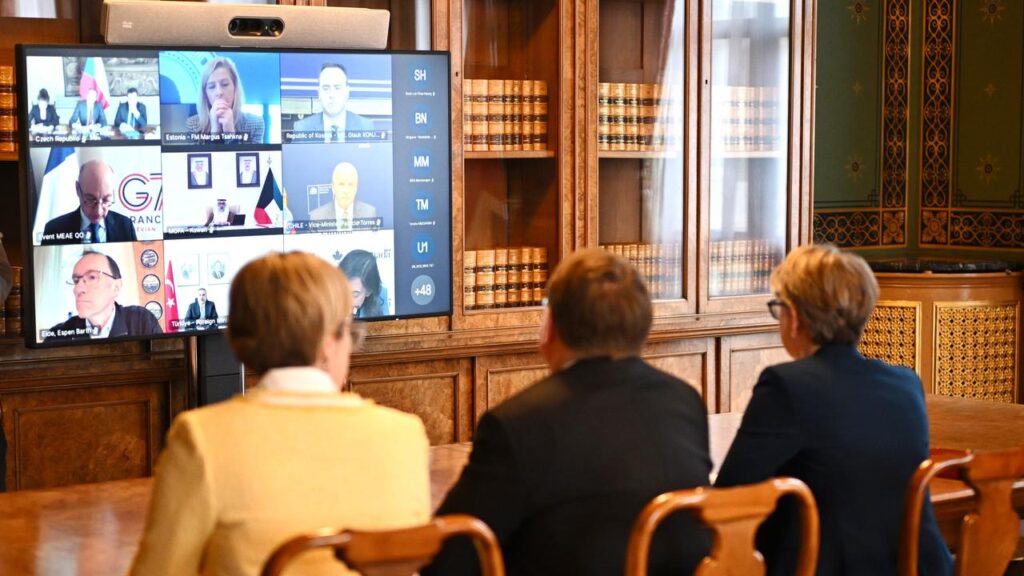
Dozens of countries are seeking ways to restart vital energy shipments through the Strait of Hormuz after US President Donald Trump said securing the waterway was for others to resolve.
UK foreign minister Yvette Cooper said Iran’s “recklessness” in blockading the Strait was “hitting our global economic security” as she chaired the virtual meeting, which included Australia, France, Germany, Canada, the United Arab Emirates and India.
“We have seen Iran hijack an international shipping route to hold the global economy hostage,” Cooper said in opening remarks broadcast to the media before the rest of the meeting took place behind closed doors.

The discussions took place after Trump said on Wednesday evening that the Strait could open “naturally” and it was the responsibility of countries that rely on the waterway to ensure it was open.
Cooper said the 40-plus countries at the meeting – up from the 35 announced on Wednesday – discussed “diplomatic and international planning measures” to ensure the strait can reopen safely, and action to guarantee the safety of 20,000 seafarers on 2000 ships trapped by the conflict.
Iran has largely shut down the key waterway, which carries about a fifth of the world’s total oil consumption, in retaliation for US-Israeli strikes which began in late February.
Reopening it has become a priority for governments around the world as energy prices soar.
European diplomats said putting the coalition together was at an early stage, with the United Kingdom and France leading.
Officials said the discussions on Thursday would focus on which countries were prepared to participate.
The UK said it would host a meeting of military planners for talks next week.
Trump said on Wednesday evening that other countries that use the Strait of Hormuz should “build up some delayed courage” and “just grab it”.
“Just take it, protect it, use it for yourselves,” he said.
But France’s President Emmanuel Macron speaking in South Korea on Thursday said seizing the Strait militarily was an “unrealistic” option.
“It would take an indefinite amount of time, and it would expose all those who venture through this Strait to coastal risks from the Revolutionary Guards, as well as ballistic missiles,” he said.
Iran’s armed forces responded to Trump with a warning for the United States and Israel of “more crushing, broader and more destructive” attacks in store.
The war will continue until the “permanent regret and surrender” of Iran’s enemies, said Ebrahim Zolfaqari, spokesman for the Iranian military’s Khatam al-Anbiya central headquarters, in a statement carried by Iranian media.
Iran was drafting a protocol with Oman to monitor traffic in the Strait of Hormuz, Deputy Foreign Minister Kezem Gharibabadi said.
“Of course, these requirements will not mean restrictions but rather to facilitate and ensure safe passage and provide better services to ships that pass through this route,” Gharibabadi said, according to the IRNA news agency.
Ships will need permits and licences in agreement with Iran and Oman, Gharibabadi also told Russia’s Sputnik news agency.
Trump posted a video on social media on Thursday of what he said was the biggest bridge in Iran being taken down in a strike and declared it was time for Iran to make a deal “before it is too late”.
A highway bridge linking Iran’s capital Tehran to the western city of Karaj was hit by air strikes on Thursday, Fars news reported, adding that early assessments point to several injured people and that other areas of Karaj were struck.
At 132 metres high, it was the highest bridge in Iran and an important route for commuters from Karaj to Tehran.
with DPA and AP
Reuters