Crane falls on a train in Thailand, killing at least 30
Jintamas Saksonchai and Wasamon Audjarint |
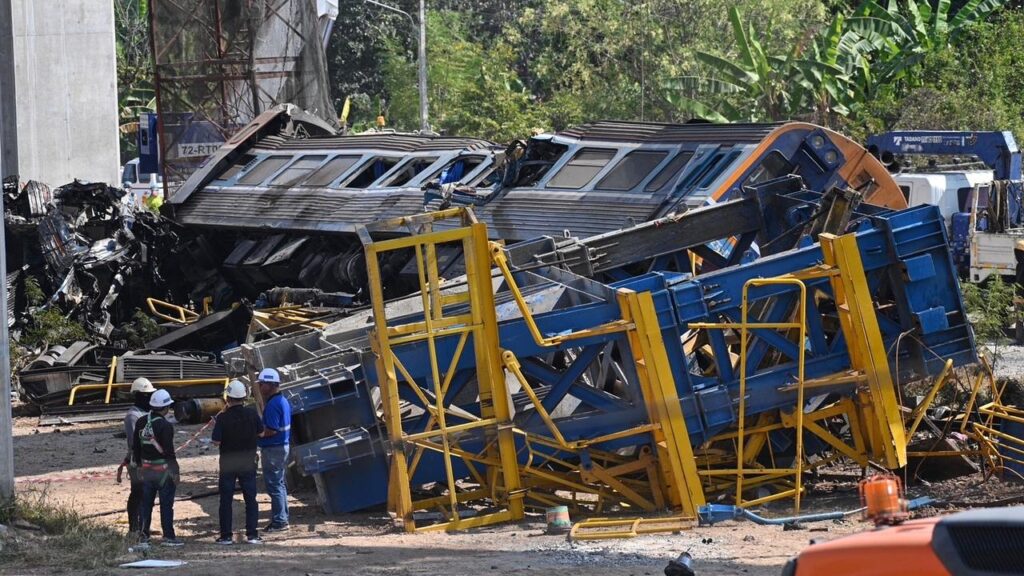
A construction crane has fallen onto a moving passenger train, causing a fiery derailment that killed at least 30 people and injured scores in northeastern Thailand.
The derailment on Wednesday occurred on part of a planned high-speed rail project that will eventually connect China with much of Southeast Asia.
Anuphong Suksomnit, the governor of Nakhon Ratchasima province, where the accident took place, said four passengers among the 171 believed to have been on board the train were still missing.
Searchers were still looking through the wreckage about eight hours after the morning crash.

The crane, which was being used to build an elevated part of the railway, fell as the train was travelling from Bangkok to Ubon Ratchathani province, authorities said.
Photos published in Thai media showed plumes of white then dark smoke above the scene, and construction equipment hanging down from girders between two concrete support pillars.
Rescue workers extricated survivors from mangled, overturned carriages
Rescue workers stood on top of overturned railway carriages, some of them with gaping holes torn on their sides, video from public broadcaster ThaiPBS showed.
What appeared to be sections of the crane were scattered along the track.
Transport Minister Phiphat Ratchakitprakarn said he has ordered an investigation.

In August 2024, a railway tunnel on the planned route, also in Nakhon Ratchasima, collapsed, killing three workers.
Days of heavy rainfall were believed to have been a factor in the collapse.
The elevated segment that collapsed is a part of a Thai-Chinese high-speed railway project linking the national capital Bangkok to the northeastern province of Nong Khai, bordering Laos.
The two-stage rail project has a total investment cost of more than 520 billion baht ($A25 billion) and is associated with an ambitious plan to connect China with Southeast Asia under Beijing’s Belt and Road Initiative.
Anan Phonimdaeng, acting governor of the State Railway of Thailand, said the project’s contractor was Italian-Thai Development, with a Chinese company responsible for design and construction supervision.
He said authorities would examine the responsibilities of both parties, and the railway department planned to take legal action against the contractor as a first step.

Damage to the train was estimated to be more than 100 million baht, while construction equipment suffered limited damage, Anan said.
A statement posted on the company’s website expressed condolences to the victims and said the company would take responsibility for paying compensation to the families of the dead and hospitalisation expenses for the injured.
The new accident sparked outrage in Thailand because the main contractor for the route’s first stage between Bangkok and Nakhon Ratchasima, Italian-Thai Development, was also directly responsible for construction on the stretch where the accident occurred.
The company, also known as Italthai, was also the co-lead contractor for the State Audit Building in the Thai capital Bangkok, which collapsed during the construction stage in March during an earthquake in neighbouring Myanmar.
About 100 people were killed in the collapse, which was the only major structure in Thailand to suffer such serious damage.
Dozens of executives were indicted in connection with the disaster but none have yet been tried.
AP