At least six killed during protests over Iran’s economy
|
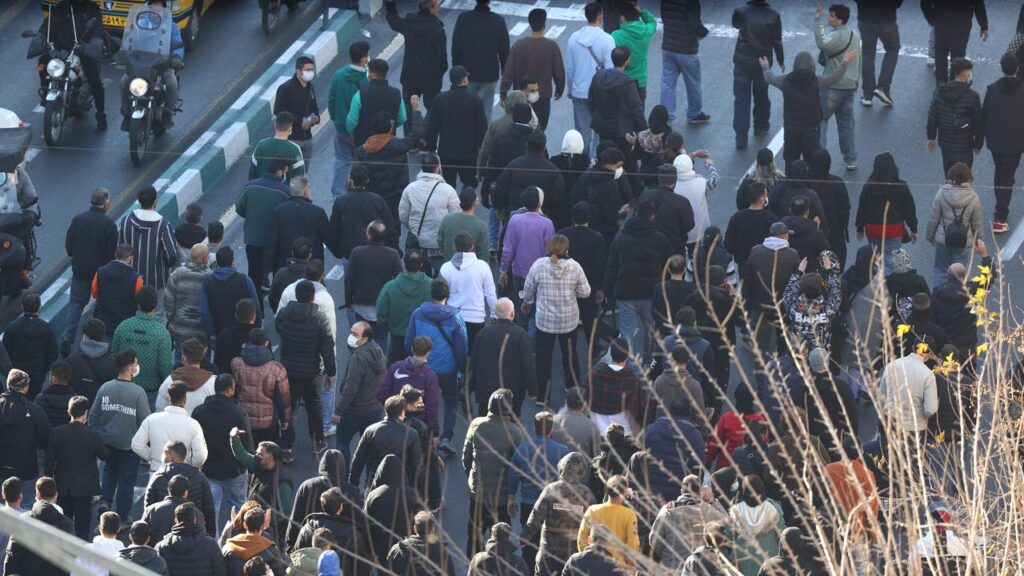
At least six people have been killed in Iran as the biggest protests to hit the Islamic Republic for three years over worsening economic conditions sparked violence in several provinces.
The deaths may mark the start of a heavier-handed response by Iran’s theocracy over the demonstrations, which have slowed in the capital, Tehran, but expanded elsewhere.
The fatalities, one on Wednesday and five on Thursday, occurred in three cities predominantly home to Iran’s Lur ethnic group.
The most-intense violence appeared to strike Azna, a city in Iran’s Lorestan province, some 300km southwest of Tehran. Rights group Hengaw reported three deaths in the city.
Authorities also confirmed fatalities in the western city of Kuhdasht and the central province of Isfahan.
The clashes between protesters and security services mark a significant escalation in the unrest that has spread since shopkeepers began protesting on Sunday over the government’s handling of a currency slide and rapidly rising prices.
Iran’s Revolutionary Guards said one member of its affiliated Basij volunteer paramilitary unit had been killed in Kuhdasht and another 13 wounded, blaming demonstrators who it accused of taking advantage of the protests.

Protests also took place on Thursday in Marvdasht in the southern Fars province, the activist news site HRANA reported.
Reuters could not immediately verify any of those reports.
The Washington-based Abdorrahman Boroumand Centre for Human Rights shared an image of what appeared to be an Iranian police officer, wearing body armour and wielding a shotgun.
The unrest comes at a critical moment for Iran’s clerical rulers as foreign sanctions hammer an economy hit by 40 per cent inflation and after Israeli and US air strikes in June targeted the country’s nuclear infrastructure and military leadership.
Iranian authorities have responded to the protests with an offer of dialogue, an apparently conciliatory gesture alongside a security response.
Government spokeswoman Fatemeh Mohajerani said on Thursday that the authorities would hold a direct dialogue with representatives of trades unions and merchants but without giving details.
The Basij is a volunteer paramilitary force loyal to Supreme Leader Ayatollah Ali Khamenei.
It is affiliated with the Islamic Revolutionary Guards Corps, which on Thursday accused those involved in the unrest in Kuhdasht of “taking advantage of the atmosphere of popular protests”.
Merchants, shop owners and students in a number of Iranian universities have been demonstrating for days and closing major bazaars.
Authorities have in recent years quashed protests over issues ranging from high prices, droughts, women’s rights and political freedoms, often with tough security measures and extensive arrests.
The Iranian rial lost about half its value against the US dollar in 2025, with inflation reaching 42.5 per cent in December.
Iran’s civilian government under reformist President Masoud Pezeshkian has been trying to signal it wants to negotiate with protesters.
However, Pezeshkian has acknowledged there is not much he can do as Iran’s rial currency has rapidly depreciated, with $US1 now costing 1.4 million rials.
with AP
Reuters