Aussie firm to roll out AI-in-a-box in regional areas
Jennifer Dudley-Nicholson |
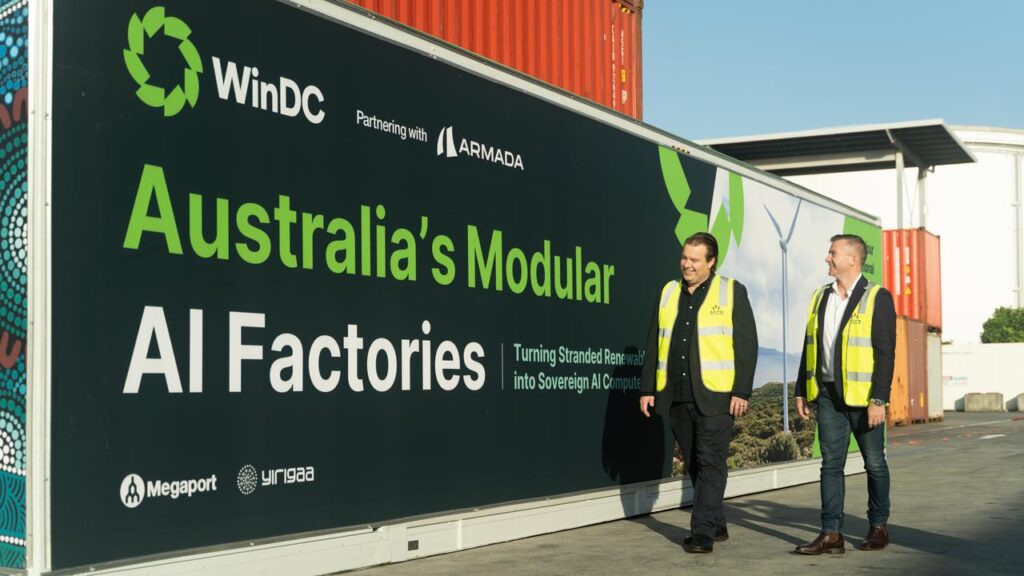
Artificial intelligence hubs resembling shipping containers will be installed across Australia to boost the nation’s tech credentials.
Rather than being located in cities, the modular computing hubs will be deployed close to renewable energy projects in regional areas to avoid building unnecessary infrastructure.
Sydney-based WinDC revealed the plan on Monday following its partnership with US start-up Armada which will deliver the portable centres.
The announcement comes months after the federal government launched a National AI Plan that named building infrastructure as a major element in one of its three goals.

WinDC plans to deploy seven modular AI centres in regional NSW and Western Australia to demonstrate how the network operates.
The centres, which can be moved by truck, will be established alongside wind, solar and battery projects to ensure they can be powered by renewable energy without additional infrastructure.
The solution would give Australia an advantage over other nations, WinDC chief executive Andrew Sjoquist said, due to its vast natural energy resources.
“Australia has the wind, the sun and the land to be a genuine force in global AI infrastructure,” he said.
“What has been holding us back is the grid.”

He said the data centres could be installed in 90 days, did not require water and could be used by companies seeking to access AI and cloud computing with a small environmental footprint.
The popularity of AI required significantly more data centres to be built and fresh approaches to tackle the issue, Armada chief executive Dan Wright said.
“The demand for real-time data processing and AI inference is growing faster than centralised infrastructure can support,” he said.
“This partnership with WinDC enables sovereign AI factories to be built where energy is produced, delivering resilient, scalable compute without waiting on grid expansion in Australia.”

One portable AI data centre had arrived in Australia, though the company said its location had yet to be finalised.
The modular centres are assembled in the US and Europe, though Mr Sjoquist said the companies planned to shift manufacturing to Australia if the model proved successful.
Australia’s National AI Plan noted data centres used four terawatt hours of electricity from the National Electricity Market in 2024, representing two per cent of all power supplied by the grid.
The Australian Energy Market Operator predicted electricity demand would triple by 2030 and could almost triple again by 2050 to use 12 per cent of the grid’s power.
AAP