High steaks: dwindling industry threatens food security
Stephanie Gardiner |
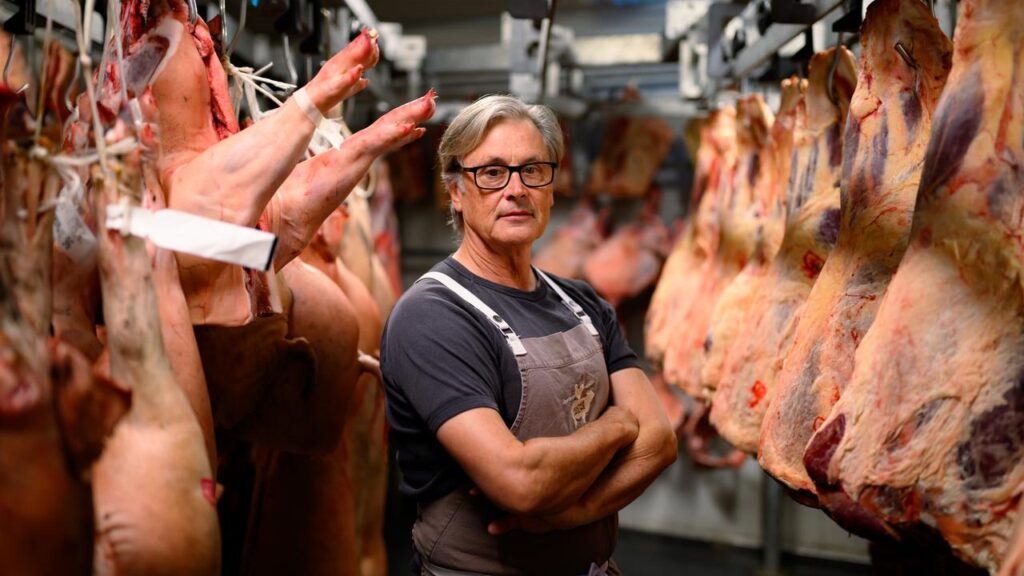
Having spent two decades working among the carcasses of cattle, sheep, pigs, goats and chickens, butcher Grant Hilliard is under no illusions about where food comes from.
Mr Hilliard, the founder of Feather and Bone ethical butchery in Sydney, has long catered to restaurants and home chefs who value the provenance of their produce.
“We’re always trying to put produce that is raised in a very responsible way in front of customers and also maintain the transparency of that line,” Mr Hilliard told AAP from his warehouse in Marrickville.
“Everything we sell is branded by the farm that it came from.”

The business sources directly from regenerative farms and only takes whole carcasses, reducing waste, shortening the supply chain and increasing food traceability.
The butchery is the antithesis of industrial farming, shunning feedlots and high-turnover abattoirs.
But small and local abattoir services are dwindling, according to research released on Thursday, and Mr Hilliard is among a group of prominent chefs, authors and producers sounding the alarm.
A national survey of more than 450 small-to-medium producers found many were losing access to reliable meat processing, with two-thirds saying their local operation did not meet their needs.
One-in-10 producers had no access at all, with others reporting months-long wait times, according to the report commissioned by the Macdoch Foundation and conducted by Nous Group consultancy.
The majority of producers in Queensland, NSW, Victoria, Tasmania, South Australia and southern WA had to send their livestock to abattoirs between two and four hours’ drive away.
The report estimated up to $742 million in annual revenue was at risk if local meat processing services disappeared, while food security for rural and regional communities could become more fragile.
Under particular threat were “service kills”, in which farmers retain ownership of the meat and sell directly to consumers.

“Without intervention, local food systems will become more concentrated, less diverse and less resilient,” the report said.
Chefs and authors Kylie Kwong, Jo Barrett and Matthew Evans backed the report, along with several farmers who called for investment in on-farm processing and stronger workforce strategies.
Urban expansion was putting pressure on local meat processing, along with labour shortages, supermarket dominance and climate-driven peaks and troughs, the report said.
The research said farmers were also under pressure from global markets that rewarded volume and efficiency.
While the federal government considers its national food security strategy, Mr Hilliard said Australia had to stop looking at produce as a commodity.
“How we grow food is an issue that has tentacles into every other aspect of governance and how we organise ourselves,” he said.
“It applies to health, it applies to environment, water usage and decentralisation.
“Everything comes back to how we grow our food.”
AAP