Power debts rise as end of bill relief hits home
Kaaren Morrissey |
One of Australia’s biggest energy retailers is reporting a rise in customer bad debts as the cost-of-living crisis bites following the end of federal power bill relief.
Energy bills are a key pressure on household budgets, which continue to be stretched in the face of rising food, rent and mortgage costs.
Electricity remains one of the biggest contributors to annual housing inflation, with costs up 22.4 per cent over the year, largely following the end of taxpayer-funded rebates.
AGL Energy, which generates and sells electricity and gas to residential and business customers, on Wednesday reported an increase in its net bad-debt expense to 1.6 per cent, from 1.3 per cent.
Asked about customer hardship cases, chief executive Damien Nicks said the company had seen a small increase, as was expected in the year.
“We are acutely aware of the cost-of-living pressures our customers are facing, as you see playing through the broader economy,” he told AAP.
Federal Labor’s bill relief of $450 for households and $475 for small businesses ended in December.
AGL provided $27 million in direct financial support for more than 20,000 customers through targeted relief for vulnerable people and state government hardship grants.
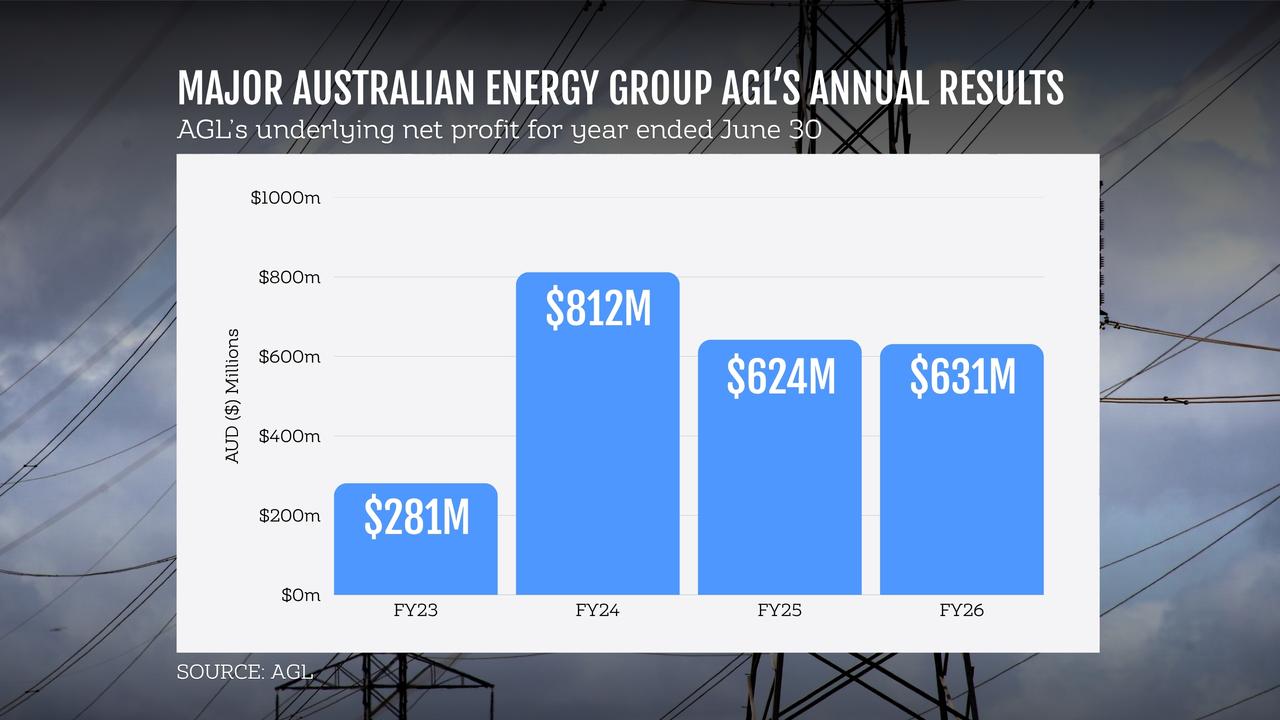
The company reported an annual underlying net profit – which strips out some one-off and volatile items – of $631 million, which was down almost two per cent from the year before.
The 2025/26 result was in the middle of the group’s guidance for an outcome between $580 million and $680 million for the year ended June 30.
Mr Nicks described the figures as a “very solid result” given mild temperatures through the year, which tend to reduce energy needs.
“May and June were some of the mildest weather we’ve seen in a long time,” he said.
AGL reported a bottom-line net profit of $756 million, up from $112 million in the previous year, mainly driven by a one-off gain of $268 million from the sale of a renewable energy asset.
However, the company said its results were supported by stronger consumer electricity and gas margins.
“What we saw was an increase in customer numbers – that was the major driver there,” Mr Nicks said.
AGL lifted total customer services to 4.6 million, up 92,000 from the previous year, while customer satisfaction rates rose to 84.1 per cent from 81.6 per cent.
The company continues to pivot its portfolio from coal-fired power plants to renewables and batteries as it steps up to meet the climate change-driven energy transition.

It has 930 megawatts of grid-scale batteries installed and managed, as well as 1.7 gigawatts contracted or in delivery.
It is also in talks with potential investors for more than 2GW of renewable projects.
Looking ahead, Mr Nicks continues to see big opportunities for the company to support the energy needs of power-hungry data centres for artificial intelligence applications.
“The big opportunity, which I think is enormous right now for energy markets, is the growth of data centres,” he said.
“We are starting to see that play through … the opportunity to have data centres at our locations is also enormous.”
AGL was looking to line up long-term contracts and getting assets built to support that demand, Mr Nicks said.
The company declared a final dividend of 26 cents per share, taking the annual total to 50 cents.
Its shares were up almost five per cent to $8.63 by lunch on Wednesday.
AAP