Humpback whale clocks new record after mega migration
Duncan Murray |
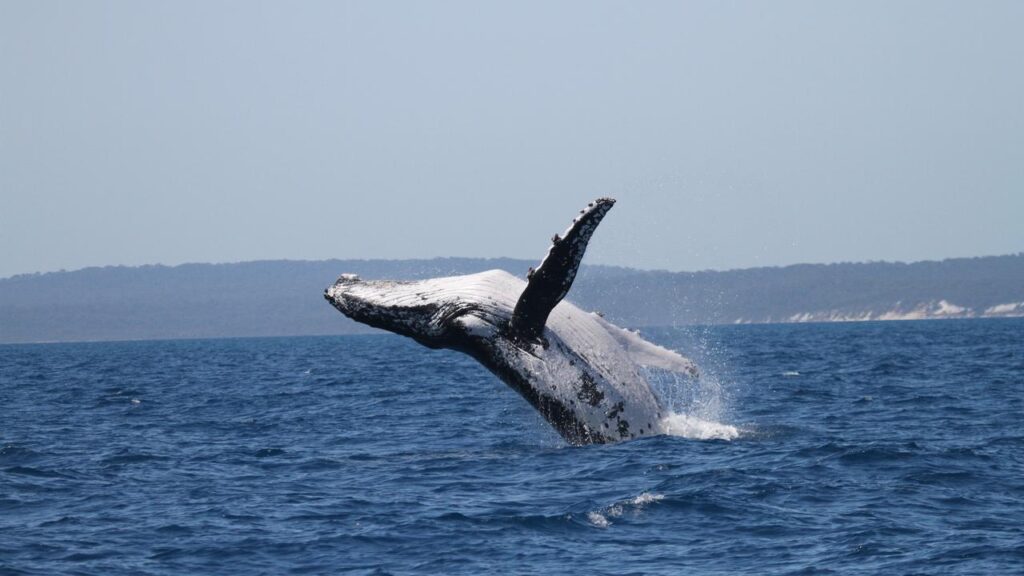
An impressive 15,100 kilometres of ocean separated sightings of one very adventurous, or very lost, humpback whale more than two decades apart, with scientists calling it new record migration for the species.
Recognisable by their unique fluke – or tail – pattern, that whale and one other were recorded in rare sightings at breeding grounds both in eastern Australia and off the coast of Brazil.
One of the whales was first photographed of the coast of Bahia, Brazil in 2003, at the Abrolhos Bank – the country’s main humpback whale nursery.
It was spotted again twenty-two years later, in September 2025, in Hervey Bay, north of Brisbane, 15,100km away.
The finding sets a new record for the greatest distances ever confirmed between sightings of an individual humpback whale anywhere in the world.
Another whale was first photographed in Hervey Bay, Queensland in 2007, and again off the coast of São Paulo, Brazil in 2019, a straight-line distance of about 14,200km – roughly the same as from Sydney to London.
Because only the start and end points of both whales’ journeys were documented, the actual route and therefore the true distance they travelled remains unknown.
One theory as to how the whales ended up where they did is known as the ‘Southern Ocean Exchange’ hypothesis, whereby they may have joined up with a different breeding population after following them home from shared feeding grounds in Antarctica.
The whales are the only two to have travelled such great distances out of more than 20,000 individual whales whose flukes were analysed for the study using an automated algorithm.
Griffith University PhD candidate and co-author of the study, Stephanie Stack said the findings were only possible thanks to the hard work of citizen scientists who contributed thousands of images over more than four decades.
“These whales were photographed decades apart, by different people, in opposite parts of the world, separated by two different oceans, and yet we can connect their journey,” she said.
Ms Stack explained despite the rarity of such long migrations they may play a key role for the long-term health of whale populations.
“Occasional individuals moving between distant breeding grounds can help maintain genetic diversity across populations and may even carry new song styles from one region to another,” she said.
Lead researcher Dr Cristina Castro from the Pacific Whale Foundation said every photo contributes to the scientific communities understanding of whale biology.
“And, in this case, helped uncover one of the most extreme movements ever recorded,” she said.
AAP