Australia turns to Japan to help soften ‘global shocks’
Tess Ikonomou and Andrew Brown |
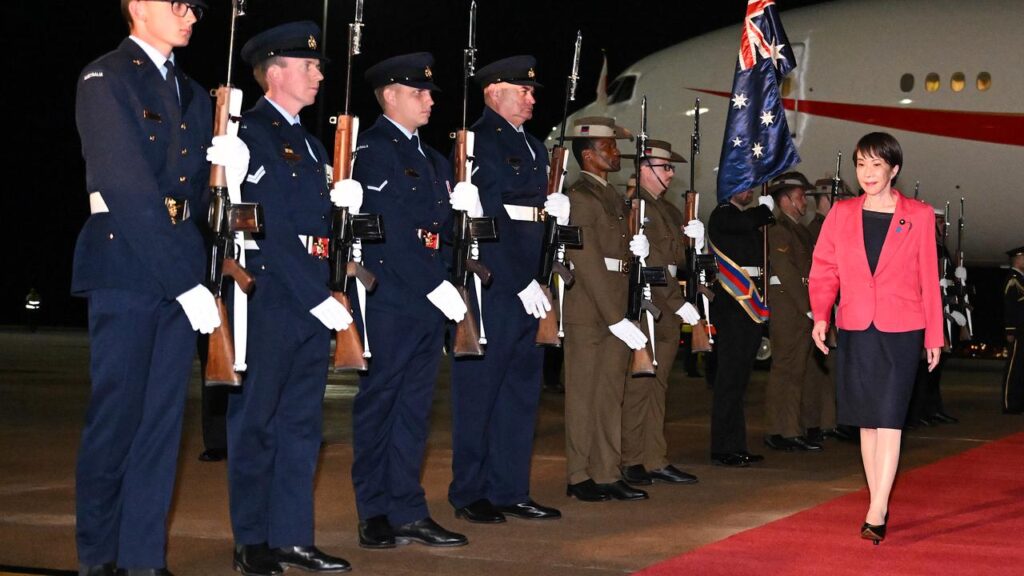
Australia and Japan have signed agreements to elevate a “quasi-alliance” between the two nations across issues including economic security.
Prime Minister Anthony Albanese and his Japanese counterpart Sanae Takaichi on Monday announced deeper co-operation on defence, security, critical minerals, cybersecurity and trade.
Giving joint remarks, Mr Albanese said the agreements were to the benefit of both nations.
“For Australians, it will mean we are less vulnerable to global shocks like we are seeing right now because of conflict in the Middle East,” he said.
“It will mean more security for farmers when they are planning their crop and more certainty for commuters filling up their car today.”
Ms Takaichi said the closure of the Strait of Hormuz as a result of the Iran war was inflicting enormous impact on the Indo-Pacific.
“The two countries have built a relationship as frontrunners in co-operation among like-minded countries by advancing pioneering security co-operation at a level that could be described as quasi-allies,” she said.
The major agreement, a joint declaration on economic security co-operation, is set against expanding Chinese military might in the region.
The statement outlines a deal for both nations to consult the other on economic security measures as well as ways to reduce risk.

Critical minerals were labelled a core pillar of the relationship to drive investment in projects that address supply chain vulnerabilities.
This will be in a bid to enable greater access to capital and technology, as well as create stronger commercial links for Australian producers.
On defence and security, both nations agreed to increase information sharing, co-sustainment of defence capabilities and advanced weapons testing.
Canberra chose Japan’s Mitsubishi Heavy Industries to supply its upgraded Mogami-class frigate for Australia’s navy in a $10 billion deal.

Ms Takaichi said she was pleased the agreement had been finalised, and pledged Japan would steadfastly follow through on the contract.
The two governments also agreed to establish an Australia-Japan Leadership Dialogue that will include academia and business groups.
Earlier, Mr Albanese welcomed the Japanese leader to Parliament House where she received a gun-salute.
School students waving Japanese and Australian flags greeted the pair, before they posed for a selfie in parliament’s marble foyer.

The visit marks 50 years since the signing of a treaty that established relations between the two nations.
Foreign Minister Penny Wong played down reports the talks could turn to a Japanese back-up for the $368 billion AUKUS submarine deal with the US and UK.
In a report for the Australian Strategic Policy Institute, former defence official Richard Gray said that risks in the AUKUS program could leave the country without a submarine.
He recommended Japan as an attractive partner to explore contingencies.

Senator Wong said Australia would continue to focus on AUKUS.
“We have a clear AUKUS plan, that is our focus,” she said.
The conservative Japanese leader, who considers former British prime minister Margaret Thatcher an inspiration, won a massive election victory in October giving her a mandate to push through key reforms.
During her trip, Ms Takaichi laid a wreath at the Tomb of the Unknown Soldier at the Australian War Memorial and visited Governor-General Sam Mostyn.
AAP