Australia’s co-working boom moves from city to suburbs
Derek Rose |
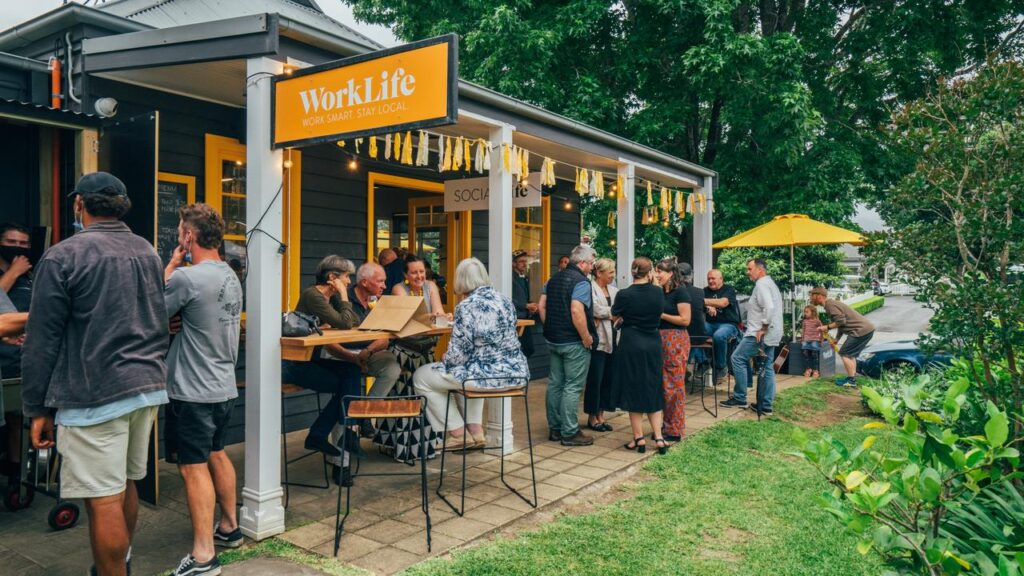
More Australians are taking up desks in coworking spaces, as the flexible venues move beyond Australia’s capital cities and into the suburbs and regional areas.
Flexible Workspace Australia’s 2026 industry report shows the client base of flexible workspaces has moved beyond startups, small businesses, and freelancers to include established corporations.
“Co-working is no longer a phenomenon or fad but an established and expected way of working,” the report released on Thursday said.
Desk rates have trended higher, vacant flexible floorspace has tightened dramatically, and operator sentiment is overwhelmingly positive, according to the report, which is based on a national survey of flexible workplace operators, industry data and expert contributions.

As hybrid work and AI become embedded in businesses, the role of flexible space will only expand.
“We expect to see continued growth across suburban and regional markets, increased adoption by enterprise organisations, and further innovation in how spaces are designed and adopted,” the report said.
Ophelie Cutier, the report’s main author and the chief executive of Perth and Sydney based startup hub Spacecubed, has been in the flexible workspace industry for 14 years.
“In Australia, the industry was definitely in its infancy when I started, and there had been huge growth before COVID,” Ms Cutier told AAP.
But many smaller operators didn’t survive the pandemic lockdowns, with half of all spaces in Sydney and Melbourne shutting down.
The report found the industry has rebounded and is growing once again, although slower than it did before the pandemic.
“One of the trends we’ve seen in the last three years is that the allocation from landlord to flex space has doubled in the last three years,” Ms Cutier said.
“So that’s a very big uptick.”
The report also found that pricing had normalised above pre-pandemic levels and remains resilient.

The median desk rate for a co-working space ranges from around $500 per person in central Hobart to $1000 per person per desk in Sydney’s CBD, although spaces outside CBDs are considerably cheaper.
“What I am noticing a lot is a real desire for suburban and flexible co-working operators, and I love that because it’s a field we play in,” said Jessie Grew, co-chair of Flexible Workspace Australia.
Ms Grew is also chief executive of Wotso, which has 42 coworking hubs across Australia and New Zealand.
“We are seeing a growing number of landlords wanting to put coworking into their assets, in particular in the suburbs and regions, because they’re looking for this service,” she said.
“It’s become like the gym or the childcare centre or the coffee shop, it’s needed as part of an asset’s genetic makeup, because it helps bring people to the asset.”
Wotso is looking to expand into Bundaberg and Harvey Bay in Queensland and out in NSW as far as Orange, Ms Grew said.

“We feel like we have a really big impact in those areas, because there’s often not a purpose-built space for small to medium businesses.”
Given higher fuel costs, larger businesses are also looking at dispersing their workforce, and offering employees a central CBD office as well as closer-to-home solutions a couple of days a week.
The typical user of a coworking space varies quite a bit by location with some of Wotso’s hubs attracting plumbers and builders and others popular with tech workers.
A two to four person office tends to be the most popular offering.
Hub Australia, a major coworking player that’s more active in central business districts, boasts well-known corporate clients including Fujitsu, Monday.com, Xero, Village Roadshow Pictures and Vanguard.
While flexible workspaces make up only a tiny fraction of the 5.3 million square metres of office space in Sydney’s CBD, they’re starting to dominate.
Slightly more than half, or 53 per cent, of all five to 10 person offices in Sydney are flexible workspaces, as are more than three-quarters of all one to four person offices, the report said.
The report also found most coworking spaces were used by local small businesses, as well as freelancers, remote workers and startups.
Corporations made up about a third of tenants.
Brett McAllen, the chief executive of @WORKSPACES, which offers serviced offices in Melbourne, Brisbane and the Gold Coast, said that demand had accelerated significantly from businesses of all sizes.

“We are seeing a fundamental shift in how businesses think about office space,” he said.
“Long-term leases are being viewed as a liability.
“Businesses want premium environments, but they want flexibility, control and the ability to scale up or down without being locked in.”
Workforces are more dynamic, teams are more distributed and business conditions are less predictable, so companies want the ability to respond quickly to changing business conditions.
“This is about agility,” Mr McAllen.
“If your workspace cannot adapt, it becomes a constraint rather than an asset.”
AAP