Mullally becomes first female archbishop of Canterbury
|
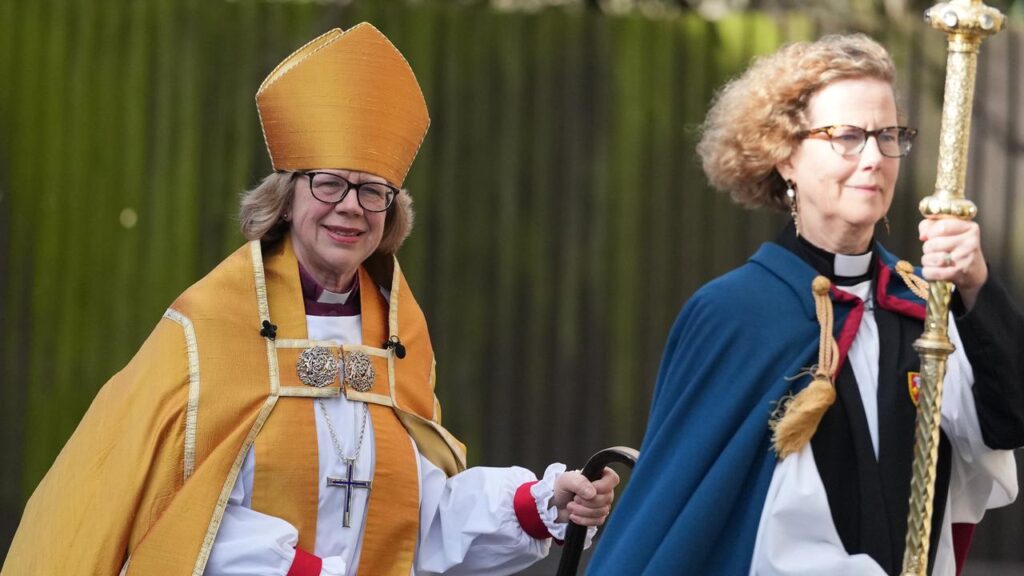
Sarah Mullally has been enthroned as the Church of England’s first female archbishop of Canterbury, taking the helm as the spiritual leader of 85 million Anglicans worldwide in a historic ceremony blending tradition with global symbolism.
The former nurse took her seat on the 13th-century Chair of St Augustine at Canterbury Cathedral before 2000 guests, including heir-to-the-throne Prince William and his wife Kate, Prime Minister Keir Starmer and religious leaders.
Delivering her first sermon as archbishop, Mullally – wearing a golden mitre and led by an African choir of singing and dancing women for part of the service – prayed for “peace to prevail” in war-ravaged parts of the world, from the Middle East and Ukraine to Sudan and Myanmar.
“As I begin my ministry today as Archbishop of Canterbury, I say again to God: ‘Here I am’,” she told the congregation.

Mullally, 63, acknowledged the sufferings caused by the Church’s past safeguarding failures, one of which caused her predecessor Justin Welby to resign, stressing the need to “remain committed to truth, compassion, justice and action”.
Before the ceremony, Bishop Philip Mounstephen, who would bless her as she was installed in the diocesan chair during the service, told Reuters that the arrival of a woman in an “ancient office … older than the Crown” was a historic occasion.
“It does signal a huge change that has taken place in the life of the Church,” Mounstephen said.
The Church of England ordained its first female priests in 1994 and its first female bishop in 2015.
While Mullally’s appointment in October drew sharp criticism from a conservative grouping of Anglican churches in mostly African and Asian countries called Gafcon, the bloc this month abandoned earlier plans to name a parallel figurehead to Mullally and instead established a new council.
A representative body within the global Communion also scrapped a previous proposal for a rotating presidency following concerns about potential rivalry with the archbishop of Canterbury.
Tensions between progressive and conservative Christians are not unique to Anglicanism but the archbishop’s role is largely symbolic and dependent on persuasion, unlike the Pope who wields clear authority over Catholics worldwide.
Recent Archbishops have struggled to bridge divisions over LGBTQI issues and women’s leadership between England’s now more progressive church and more traditionalist provinces elsewhere.
A bishop from the Anglican Church in Kenya, which is aligned with Gafcon, struck a more conciliatory tone as he arrived at Canterbury.
“Even though we hold that this (same-sex blessings) is not acceptable, we want to argue it from within to have people see also the reason why we reached that conclusion,” Bishop Francis Omondi told Reuters.

Mullally herself has emphasised unity in diversity, telling Reuters last October: “We’re a family with a shared root, and with any global church there is great diversity in it.
At the start of Wednesday’s ceremony, she knocked on the cathedral’s west door, wearing a cloak secured by a clasp modelled on the belt she wore as a National Health Service nurse.
She was then greeted by children.
Mullally wore a ring given to one of her predecessors, Michael Ramsey, by Pope Paul VI in 1966, a symbol of improving ties between Anglicans and Catholics, centuries after King Henry VIII split from Rome.
Prayers and readings in multiple languages rang through the cathedral during the service, reflecting the global reach of the Anglican Church.
Wednesday marks the Feast of the Annunciation – a celebration of the biblical account of an angel telling Mary she would be the mother of Jesus – and this was the major theme of the service.
“As I look back over my life – at the teenage Sarah, who put her faith in God and made a commitment to follow Jesus – I could never have imagined the future that lay ahead,” Mullally said.
with AP
Reuters