‘Wildly Orwellian’: legislators bypass affected groups
Andrew Stafford |
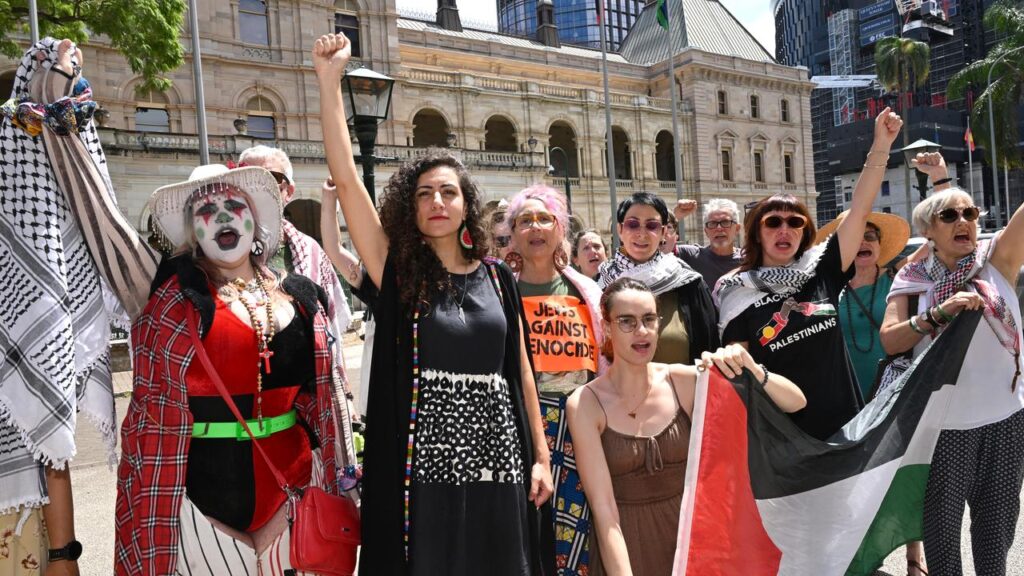
An inquiry into a state’s proposed new anti-Semitism laws has heard that multiple stakeholders were not consulted before the bill was drafted.
The Federation of Islamic Councils, the Islamic Council of Queensland and the Ethnic Communities Council of Queensland all told the state’s parliamentary committee for justice, integrity and community safety that they had been bypassed.
Under the proposed laws, the state attorney-general would have the power to outlaw phrases, the public uttering of which would be punishable by two years in prison.
The government intends to ban two phrases “globalise the Intifada” and “from the river to the sea”.
Attorney-General Deb Frecklington told a press conference that the Jewish community felt “menaced, harassed and offended” by the two phrases.
In a protest outside Queensland parliament, during which a small group of protesters chanted the second phrase, Justice for Palestine Magan-djin spokesperson Remah Naji said it was discriminatory that the group had not been allowed to appear before the committee.
Greens MP for Maiwar Michael Berkman unsuccessfully moved that Justice for Palestine Magan-djin be allowed to appear before the committee.
“It is absurd that we can hear from such a narrow set of interests,” Mr Berkman said.
“This is the Queensland government making themselves the thought police, and it is wildly Orwellian legislation.
“It’s genuinely shameful that with such significant and far-reaching legislation that the government wouldn’t consult with those groups that are affected by it.”
The proposed laws have caused concern across the political spectrum, from the free market think-tank Institute of Public Affairs to the Queensland Council for Civil Liberties and the Queensland Human Rights Commission.

Adam Moschella, from the Queensland Law Society, questioned whether the laws were already covered by existing law, expressing concerns about what he described as the “far-reaching aspects” of the bill.
Annita Stucken, assistant director of legal for Australia’s Special Envoy to Combat Anti-Semitism, would not confirm whether the envoy had been consulted and said it would provide an answer on notice.
Karen Prior, from the Jewish Board of Deputies, told the committee that the Jewish community had experienced “unprecedented levels of hate, intimidation and fear”.
“The reforms in this bill send a clear message that anti-Semitism and hate have no place in Queensland, and draw a clear line between legitimate political discourse and the promotion of terrorism,” she said.
Keysar Trad, from the Federation of Islamic Councils, told the committee that criminalising language would not solve complex social tensions, but would instead risk turning political expression into a crime.
“Once we begin policing vocabulary based on subjective trauma, we are no longer a parliament of laws, but a parliament of perceptions,” he said.
The inquiry will conclude its hearings on February 27.
AAP