National recycling pilot to stop solar energy eclipse
Jennifer Dudley-Nicholson |
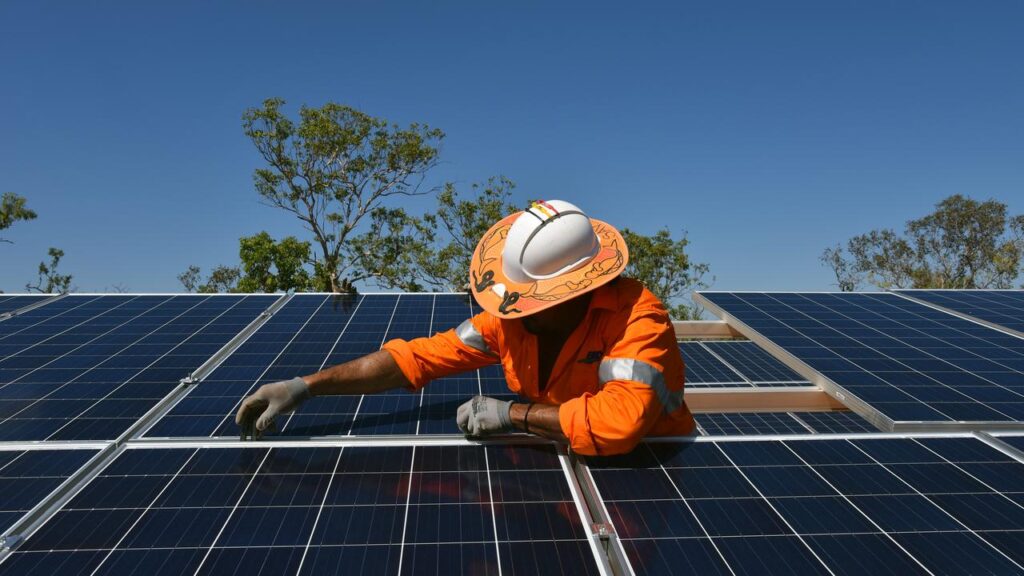
A $24.7 million pilot program will seek to address the “fatal flaw” in Australia’s world-leading uptake of rooftop solar panels: what to do when they stop working.
The federal government announced the national program at a Brisbane factory on Friday, revealing three years of funding for the program and a plan to establish up to 100 collection sites.
The announcement comes as the Productivity Commission released a report into the circular economy that recommended recycling programs to tackle electronic waste and found overall progress in Australia had been slow.

The recycling program comes six months after 60 businesses, unions, and environmental and industry groups issued a statement urging the government to address solar panel waste with a mandatory recycling scheme.
More than 4.2 million Australian homes feature solar panels, representing more than one in every three households.
But government analysis showed only 17 per cent of those panels were recycled at the end of their use, Environment Minister Murray Watt said, creating waste and failing to recover valuable metals.
“Most panels are either stockpiled, dumped in landfill or exported for reuse,” he said.
“These materials can be repurposed to support the clean energy transition and help reduce what we send to landfill.”
Solar panels, which are estimated to have a 25-year lifespan, contain recyclable materials including copper, silver, aluminium, glass, silicon, indium and germanium.

Extracting these materials could deliver up to $7.3 billion in economic benefits, according to government figures, which Treasurer Jim Chalmers said would come from greater access to metals and less pollution.
“Recycling solar panels and reusing the components will reduce costs and make our economy more productive and efficient,” he said.
The Productivity Commission report, Australia’s Circular Economy: Unlocking the Opportunities, found the switch to renewable energy sources had increased electronic waste and recommended recycling programs for small devices, solar systems and electric vehicle batteries.
A national approach would be needed to steer large-scale recycling in Australia, the report found, as it would “avoid the problems associated with misaligned state action”.
The recommendation mirrors a joint statement signed by industry groups and co-ordinated by the Smart Energy Council, which called for a mandatory solar panel recycling scheme and issued warnings about solar panel stockpiles and illegal dumping.
The statement, released in September, said Australia’s failure to recycle large numbers of solar panels was “a fatal flaw that threatens to undermine the principles of this renewable energy revolution”.
AAP