Rock wallaby fossils show they weren’t all homebodies
Lloyd Jones |
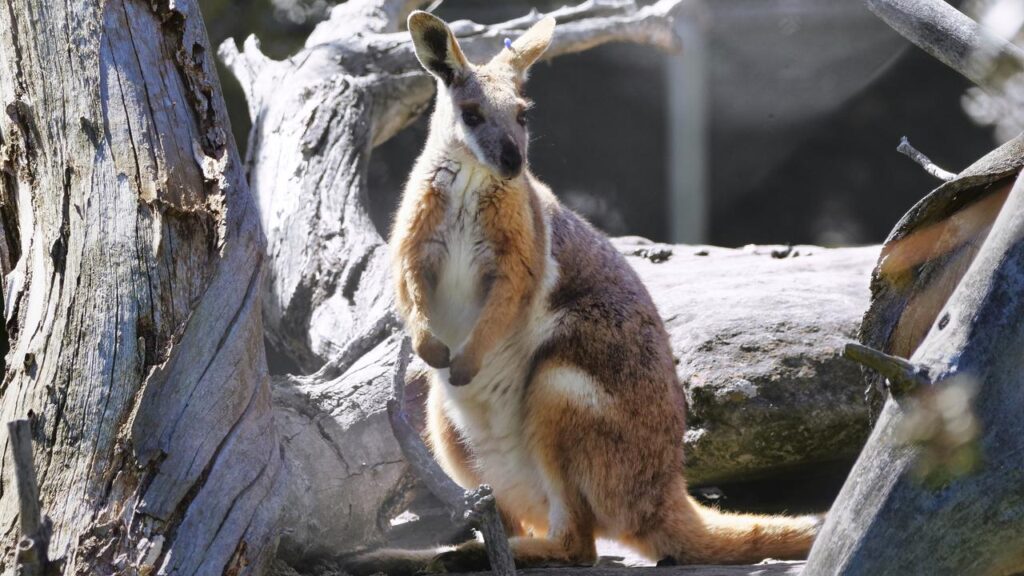
Rock wallabies may not all be the shy, cliff-dwelling homebodies they’ve been made out to be.
Fossil evidence shows a few ancient individuals travelled far afield to find others of their species, in the process improving genetic diversity and long-term population resilience.
The findings by a team of Australian scientists have implications for contemporary conservation efforts to protect rock wallaby species.
With major roads and industrial and residential development now dividing the landscape, humans might inadvertently be creating barriers for these rare but crucial dispersal events, they say.
“Future management shouldn’t view rock wallabies as isolated colonies,” said lead researcher Chris Laurikainen Gaete of the University of Wollongong.

“Long-distance dispersal has always been part of their natural history and by protecting landscape connectivity, we ensure this deep-time behaviour remains part of their future survival.”
Proving such dispersals in fossil wallabies came down to studying their teeth which incorporated unique chemicals from the food they ate, in turn linked to underlying geology.
“So any plant that grows on limestone will have a unique signature. A plant growing on a basalt rock will have a different signature, Mr Laurikainen Gaete told AAP.
“We know the caves are in a limestone block, so if they are local they will have a really limestone signature.
“But if they were feeding anywhere else in the landscape we’d see a different signature so that’s how we figure out where they were.”
Mr Laurikainen Gaete said the next step would be to apply the same technique to living rock wallaby colonies, with the study of road kill being part of that, along with genetic testing.
That could determine where the animals started from and how far they got in the landscape before they died, he said.
The study, published in Quaternary Science Reviews, found that while most rock wallabies living in central Queensland around 280,000 years ago occupied small home ranges, a few individuals were unexpectedly mobile.
At least one travelled more than 60km, including crossing the crocodile-infested Fitzroy River.
Some studies of modern rock wallabies have suggested gene flow between colonies.

But the fossil study is the first direct evidence of long-distance dispersal occurring in individual rock wallabies, maintaining links between isolated populations and supporting genetic diversity.
The researchers analysed fossil remains recovered from the Mount Etna Caves near Rockhampton.
“We used the chemical signatures preserved in fossil teeth to reconstruct how individual kangaroos moved through the landscape,” said Professor Anthony Dosseto of the Wollongong Isotope Geochronology Laboratory.
“Most were homebodies, relying on local resources, with a few notable and important exceptions.”
Dr Scott Hocknull, a palaeontologist at CQUniversity, said the study demonstrated the power of new isotopic techniques to reconstruct ancient animal behaviour at the level of the individual.
“Long-term species survival depends on individuals being able to move between habitats,” he said.
AAP