Gardens glory as four corpses bloom in one week
Andrew Stafford |
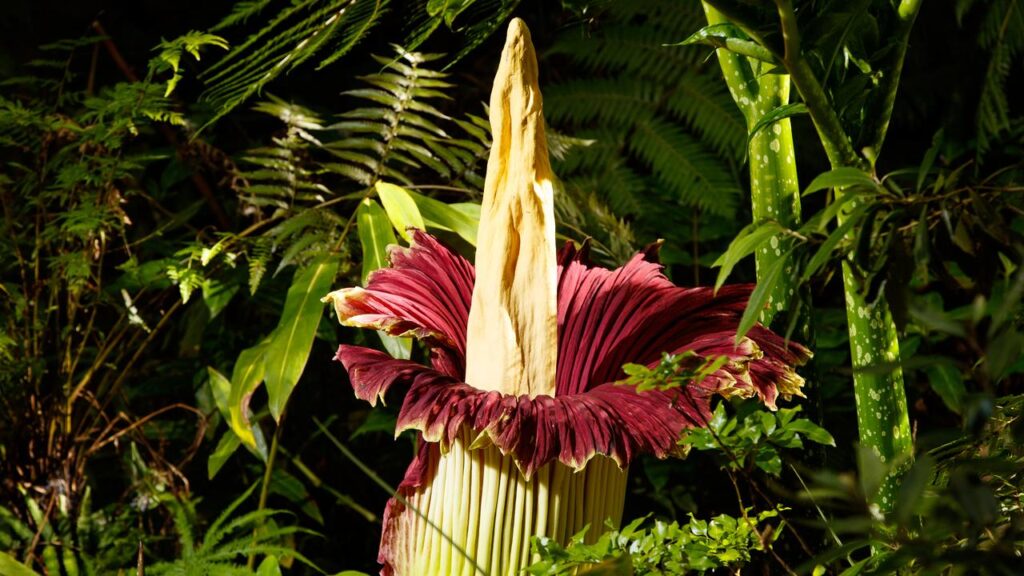
Visitors to a tropical botanic gardens are holding their breaths – and their noses – waiting for the final flowering of a rare plant.
Titan arum, better known colloquially as the corpse flower, is a large plant native to the limestone rainforests of western Sumatra, Indonesia.
The Cairns Botanic Gardens in far north Queensland holds 15 examples, three of which have opened between December 30 and New Year’s Eve.
Meanwhile, a fourth is yet to unfurl, despite gardens staff giving it “a stern talking to” in the face of national media attention and thousands of visitors.
Growing up to three metres high, Titan arum is the world’s largest unbranched inflorescence – a cluster of flowers arranged on a stem.
It emits a powerful odour likened to rotting flesh, used to attract its natural pollinators – scavenging insects which mistake it for carrion.
The plant’s scientific name, Amorphophallus titanum, refers to its erectile appearance and enormous size.
Its hundreds of tiny flowers are hidden within a burgundy sheath called a spathe that surrounds a large tube called the spadix.
Cairns Botanic Gardens staff have cut an opening in the plant’s spathe, both for visitors to observe the hidden flowers and to promote pollination.
When an inflorescence finishes after 24-48 hours, the spadix droops, a process staff refer to as “the flop”.
On Friday, a social media post reported that “the spadix is starting to list a bit and we suspect that further flopping is imminent”.
The plant then grows a single new leaf, which eventually produces another florescence – a process that repeats over the life cycle of the plant.
Titan arum is classified as endangered by the International Union of Conservation of Nature due to deforestation and over-collection.
Less than 1000 plants are thought to remain in the wild, with specimens in botanic gardens worldwide considered crucial to maintaining ongoing genetic diversity.
The most notorious example of Titan arum at Cairns Botanic Gardens goes by the name of Hannibal, which last flowered in February 2025.
Other corpse flowers held in botanic gardens around the world have also been honoured with their own names including Putricia, Pepe Le Pew, Dame Judi Stench and Fester.
AAP