Why SCG will be a fitting farewell for true trailblazer
Scott Bailey |
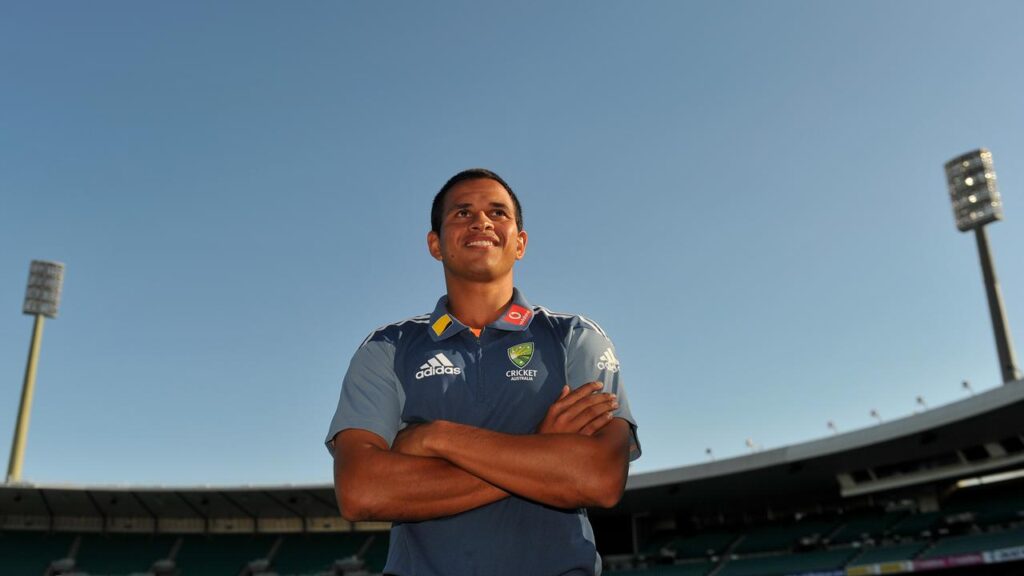
Usman Khawaja has worn more hats than most in his Test career.
The trailblazer as a young Pakistan-born Muslim Test debutant, the politician on all matters from the Middle East to gambling advertising.
There has been Khawaja the opener, Khawaja the middle-order batter, Khawaja the homeworkgate-ist, Khawaja the scapegoat who bore the brunt of the selectors’ axe more than most, and Khawaja the reborn star.
But no hat has put more of a spotlight on the left-hander than that of Khawaja as Australia’s great hope.
It’s fitting that when the 39-year-old bids farewell to the Test arena next week, it will come at the SCG against England.
Khawaja has called Brisbane home since 2012 but grew up a stone’s throw away from the SCG.
He would wait until late in a day’s play for the gates to open at the iconic ground then scuttle in for a brief taste of international cricket.
But the field of dreams also became the venue that shaped his career.
It was at the SCG, 15 years ago, that Khawaja made one of Australian cricket’s most famous 37 on Test debut.
Australia was at their lowest ebb as a team, beaten in a home Ashes for the first time in 24 years and in the middle of a run of two wins from 11 Tests.

Michael Clarke was captain for the first time, Khawaja was Australia’s first debutant to bat at No.3 in 17 years and Steve Smith hit a half-century at No.8.
After an era of utter dominance, the Australian public needed something to cling onto in the hope those glory days could return.
Enter Khawaja.
Wearing the now-unfamiliar short sleeves, the always-easy-on-the-eye Khawaja clipped his first ball for two then pulled Chris Tremlett’s next delivery to the rope.
In commentary for that 2011 Test, a typically-hyperbolic Bill Lawry compared the SCG roar to the one Steve Waugh received for his final-ball century at the ground eight years earlier.
“I’ve said a few times, that 37 was a bit embarrassing,” Khawaja said years later.
“There was a lot of carry on for a 37.”
For Khawaja, that 37 was only the start of the rollercoaster.
Some three Tests later, he found himself out of the side in Sri Lanka after scores of 21, 26 and 13no.
It was to be first of seven times Khawaja copped the axe from Test selectors.
Eight, if you include his omission in Adelaide earlier this summer before Smith’s vertigo granted a last-minute reprieve.
“Resilience is just built over the years,” Khawaja said on Friday.
“I had to be resilient when I was younger. I had a brother who was seven years and another ten years older and they gave me nothing.
“I was told my whole career that I wouldn’t play for Australia through my community and whatnot.
“Then I tried to fit into an Australian team that I didn’t quite fit into at the start.”

Khawaja, as he grew more and more comfortable with the national glare, would speak increasingly openly about how he felt the colour of his skin shaped various critiques of him.
It was the most prominent part of Friday’s retirement press conference, where he entered wearing the hat of Australia’s oldest player in 40 years.
Khawaja’s family were watching on and will be at the fifth Ashes Test.
But for most of his career, it appeared Khawaja would never get a fairytale ending to match that famous 37 on debut.
First he was written off as a man who couldn’t bat in Asia, dropped there in 2011, 2016 and 2017 as he averaged 14.62 across his first five Tests on the continent.
It prompted a rethink of the left-hander’s approach to spin, using his crease better and learning to play off the back foot far more often.
Now he is Australia’s fifth-leading run-scorer in Asia, with his average of 61.8 on the continent the second highest of any Australian with more than five Tests there.
With five centuries in his past 13 Tests in Asia, it is understandably why coach Andrew McDonald wanted him to stay on for next year’s tour of India.
“It’s pretty special to be from where I was as a guy who can’t play spin in the subcontinent to have the best average out of the top five run-scorers there,” Khawaja said.
The same was said of England, where Khawaja failed to play the final Test of the 2013 and 2019 Ashes while missing the tour altogether in 2015.
In 2023 the response was emphatic. A match-winning century in the first Test at Edgbaston before finishing as leading run-scorer for the series.
“It always seems to be the ones where people knock me down,” Khawaja said.
“I was getting nailed. I don’t score runs in England, all these things were coming. It was a tough time.”
Never did Khawaja’s career appear more over than when dropped in the 2019 Ashes, leaving him in the wilderness for two-and-a-half years.

But instead that period on the outer breathed new life into him, returning as a father and stress-free cricketer when Travis Head’s positive COVID test opened the door.
With a fresh mindset, Khawaja fittingly took his chance at the SCG with two centuries against England in the 2021-22 Ashes.
“I truly believe that was divine intervention … it was a bizarre turn of events,” Khawaja said.
“I thought my career was over.
“I was 44 games at the mark when I came back into the side in 2021 and now I’m 88 games. It’s a tale of two halves.
“I’ve definitely enjoyed the second half way more than the first half. Even though I played well in the first half.
“It was a different perspective on life that helped me get through that and I’m going to be honest, I was more mature.”
In reviving his career came Khawaja’s most-coveted cap of ‘people’s champion’, one he has worn for the final four years of his career.
“As much as I joke about it, I do call myself (that),” Khawaja said.
“I never call myself the people’s champ because I thought everyone loves me.
“It’s more because I actually feel like I’m the people’s champ because of what we’ve talked about today.
“I speak about things for the people that other people don’t want to speak about.”
Khawaja’s rein as Australia’s great hope ended years ago, long before he became a key part of the backbone of the success of the current team under Pat Cummins.

Instead he bows out wearing the hat of one of cricket’s more storied careers, among the nation’s 15 highest run-scorers in history and arguably the biggest legacy of all.
“The fairytale’s already done,” Khawaja said.
“I don’t think it matters how many runs I score … obviously, I’d love to win the game, but the fairytale’s signed, sealed and delivered for me.
“The fairytale was playing SCG (in 2022), getting the two hundreds and then having another second half of my career and being able to play it until the age of 39.”
AAP