Trump furious after US Supreme Court upends his tariffs
Jonathan Allen, David Lawder and Andrew Chung |
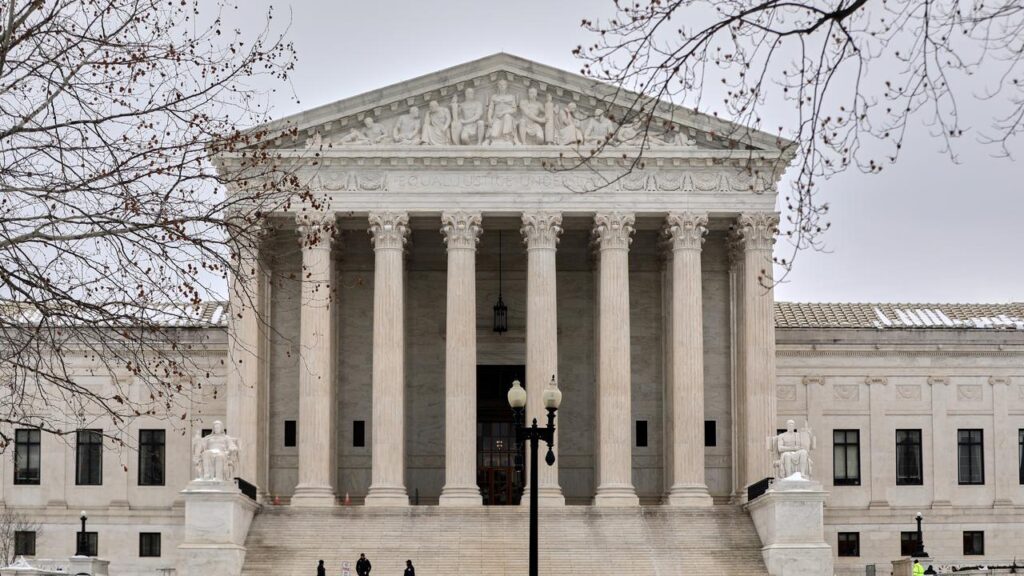
President Donald Trump has responded with fury to the US Supreme Court ruling that he does not have the power to unilaterally set tariffs on imports, denigrating individual justices as he vowed to wield a different law to continue his global trade war.
The court’s landmark 6-3 ruling on Friday upended the leverage Trump and his trade envoys have wielded over foreign governments, both allies and foes, at negotiating tables around the world to reshape diplomatic relations and global markets.
It called into question the many trade deals his envoys have negotiated in recent months under the threat of high tariffs.
It pushed all three major US stock indexes to their highest levels in weeks. And it left open the fate of the $US175 billion ($A247 billion) Trump has collected from US importers under what the court said was his incorrect reading of the law.
“I’m ashamed of certain members of the court, absolutely ashamed, for not having the courage to do what’s right for our country,” Trump told reporters at the White House, complaining that foreign countries were ecstatic at the ruling and were “dancing in the street”.
He insinuated, without evidence, that corruption played a part in the majority’s decision, which was written by Chief Justice John Roberts: “They’re very unpatriotic and disloyal to our Constitution. It’s my opinion that the court has been swayed by foreign interests and a political movement that is far smaller than people would ever think.”
Since returning to the White House 13 months ago, Trump has said he had what the court summarised as the “extraordinary power to unilaterally impose tariffs of unlimited amount, duration, and scope.”.
Citing a national emergency, he said the International Emergency Economic Powers Act (IEEPA) meant he could set tariffs at any rate he chose.

The court’s ruling was blunt: Trump has not proved the president has this power, and exceeded his authority. A tariff levied on US importers is a tax like any other, the court said, and the Constitution reserves the power to “lay and collect Taxes, Duties, Imposts and Excises” to Congress.
In response, an angry Trump said on Friday afternoon he would invoke other laws to collect tariffs, and announced a blanket 10 per cent tariff on imports from all other countries, on top of any existing non-IEEPA tariff.
In doing so, he became the first president to invoke Section 122 of the Trade Act of 1974, in which Congress said the president could levy tariffs of up to 15 per cent for up to 150 days to fix “fundamental international payments problems”.
with Reuters
Reuters